Loneliness isn’t hard to come by in a big city. Even in some of the most populated, busiest and cities in the US, like my own home of San Francisco, that ache pangs more often than one expects. Elena Oxman’s Outerlands understands this feeling in spades.
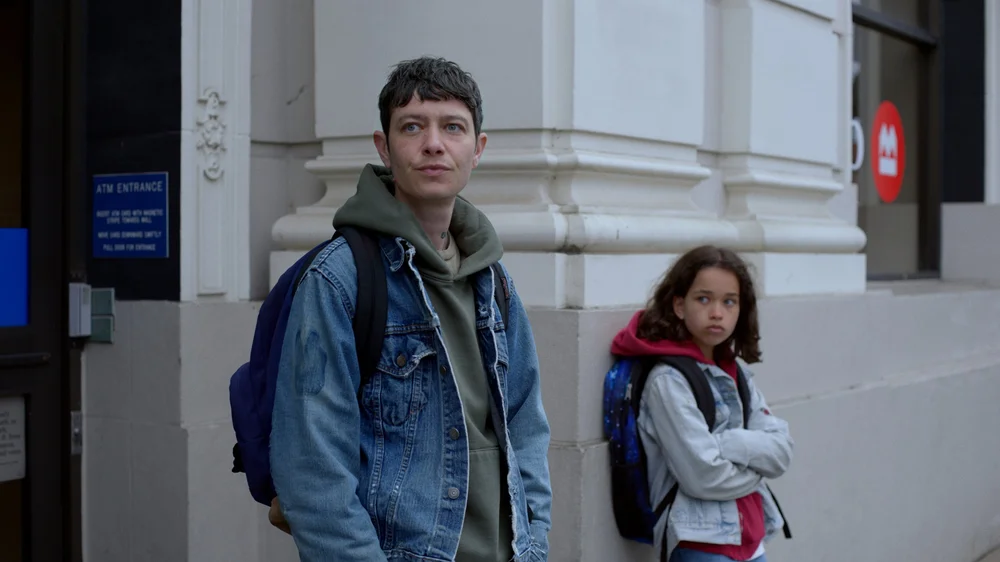
Oxman’s film is an independent feature about a young non-binary person named Cass (Asia Kate Dillon) struggling to make ends meet, who is suddenly saddled with the daughter of a one-night-stand, Kalli (Louisa Krause), who disappears on both of them. Cass and the kid, Ari (Ridley Asha Bateman), are both emotionally reserved, but learn from their time together about what it means to grow up.
Shot entirely in San Francisco — specifically the Richmond and Sunset districts, known as the city’s outerlands — the film is now up for Best First Screenplay at the Film Independent Spirit Awards. I sat down with Oxman to speak about how their film came to be and what they’re excited about in the future.
AUGUST: Tell me a little bit about how the first notions of the film came to you and what the initial spark was.
ELENA: There were a bunch of different strands in my personal life [August’s cat hops into view] – Oh my gosh! Sorry, I’m a cat person – I was going through a part of my life where I was thinking a lot about the inner child and this idea that we’ve all got these little kids inside of us and what it means to think about who you were when you were a kid. So much of adulthood, you’re just hustling, right? Just through it. You’re doing things and then there’s a certain moment – in my experience – that’s like, “Oh, whoa. What happened?” I was really interested in this relationship between our adult selves and our younger selves. In my own experience, I was forming a relationship with my younger self. I remember I would keep pictures of myself at age 10 or 11 and, in a way, it’s looking at a stranger, but in a way, it’s looking at the most intimate relationship you have because it’s like, “Whoa, who is this? Wow, this is me.” We all have this. We all have these inner kids that tend to be forgotten. I was really interested in this idea of what it means to love your inner child, to come into a relationship and take care of them and ask them what they went through and what they’re going through now. I know how that all sounds. There’s a line in the movie where the banker says, “You know, it’s woo woo, but it works.” That realm of almost a psychological impulse, that was one layer, and another layer was I had made a short film called Lit in 2014 that was about this character who just had a lot of qualities that I recognized in myself that I was interested in. Guarded, a little bit of a lone wolf type of character, someone who’s put up walls, maybe for good reason, and is going through the world hungry for connection but not knowing exactly how to find it. I wanted to see that person on screen and imagine what their life was like and what a journey toward finding that connection both with other people and themselves would look like. That’s where Cass came from. Then my wife worked as a nanny for years in San Francisco. I had contact with that world and would meet up with her walking around the city with the little kid she was taking care of. She really inspired that part of the movie. Same with the people that I knew who were living in this situation where they – and this wasn’t me, because I’m a transplant to the city, Cass is a transplant too – were experiencing what it’s like to have this place that you’d come for refuge be changing so rapidly that you couldn’t afford to live there anymore. So that was also something I was in contact with. All those things came together to form the idea for Outerlands.
AUGUST: The title speaks to the emotional state of Cass, but also what Cass is feeling in the outer lands of their own social life. They’re dodging a lot of either responsibility or opportunities. Then it’s also set in what people would call the outerlands of the city, in the Richmond and the Sunset. What drew all of those thematic ties together for you?
ELENA: When I first moved to the city, I moved to the Inner Richmond. That’s where I set the short film Lit, which was a sketch for Outerlands. I was taken with the urban landscape there. There was this quality of the older San Francisco, a little more ragtag than other parts, where you could still feel the layers of history peeking through. I loved that. I have a background in documentary, I’ve always made films about the changing landscape. I’m very interested in impermanence in general and how we live with that and how the outer landscape can reflect something very inner. I’m a super nostalgic person, so I’ve always been drawn to the older parts of cities. There’s a lonely feeling as you get out toward the ocean, there’s something existential. There’s not a lot of cities like that, right on the ocean, and I was really drawn to that. There were so many hangouts and places I wanted to film, even things like the Star of the Sea church. There’s something so beautiful about that church and the connection to the ocean and there’s a theme that runs though the movie — you could call it the divine feminine in a way. Like the grotto with the Virgin Mary and the rainbow flag on the outside of it. The way the ocean is associated with Kalli and there’s a sense of Cass’s longing to reconnect with a mother principal in some way. There was a lot about how the textures of that landscape were resonating with the character. It’s funny, interviews always ask these questions, I think these things are all happening at an almost pre-verbal level and in the interview, they get verbalized. But that makes sense.
AUGUST: Speaking of motherhood, I feel like that’s a major theme throughout the film. Cass is seeking that [maternal and parental figure], because we never really find out what happened with their mom, but obviously something traumatic or life-altering in some way. There’s the trouble with Kalli, there’s what Ari’s going through and there’s the heroic banker who steps in as this magical sage figure. How did motherhood affect your writing of the film? Did you know this would be something that these characters would be dealing with?
ELENA: I knew that with this inner child theme I was interested in, ultimately it was about Cass reparenting themselves. I knew that’s where the film was going. I knew I didn’t want to be blaming – I mean mothers already get way too much blame for everything – I knew I didn’t want to have a film that conveyed things in that way, but I also feel like the mother just as an image, as an idea, it brings up such a primal sense of that which we are looking for to nurture us, to unite us, to somehow make everything better. It became more like a symbol mother in a way. I wanted to suppress a lot of the details because I didn’t want to make it about a mother that either failed Cass or is in any way thought of as “the bad mother.” It became an idea of a need that [Cass] didn’t get met and they then have to go on this journey to meet themselves. Meanwhile, they’re looking in the wrong places for it, like Kalli or alcohol. It felt important to me to, with Kalli, that there’d be a sense of, as much as we wish she wasn’t making the choices that she’s making in the movie, that we’re not like, “Oh, that’s a bad mother.” There’s a sense of someone who’s doing the best that she can. That theme of Mother is a source of caring that we all ultimately need to find in ourselves.
AUGUST: Speaking of Kalli and motherhood, at the center of this all is Ari, who is being pulled between those worlds in a way. She’s being pulled between Kalli and Cass and school and doesn’t really know what to make of it. She’s at a point where childhood is a state that you can’t escape and clearly she does want some independence that isn’t afforded to her. How did you go about casting that role? Because without her, the movie doesn’t really work.
ELENA: My first impulse with that character was, “We’re not going to find a trained actor. This has to be a non-professional,” because it felt so important that the character be very real feeling. I turned out to be totally wrong about this, that we wouldn’t find a trained kid because of the authenticity factor. I’m glad that our casting directors Alison Estrin and Henry Russell Bergstein talked me into doing auditions as at least a first step. We did a national search and Ridley was in Atlanta and had done film work before. She came into the audition,, and then we did a callback. It was so obvious that she was Ari. She could take direction in the call back, but then had this almost uncanny naturalness to the performance. The script, Ari’s lines, they’re very simple. I really just wanted her to feel like a normal kid. I have a pet peeve when kids don’t talk how kids talk. What I really needed to come through was a kid who was guarded, and really self-sufficient and determined to protect her mom, but underneath all that, you can sense intense vulnerability that had to be there too. Some of that’s conveyed simply through the eyes, through how she looks, and [Ridley] really just had all that and it was clear. So that was amazing, getting to see her audition and then see, “Oh, that’s clearly Ari.”
AUGUST: The tone of the film does meet its characters where they’re at a lot of the time. It tends to follow Cass’s state of mind and being, but that also means getting into a very dramatic tone. There’s that operatic score that repeats throughout. How did you go about balancing the tone? There’s both a light touch to the film and a proper weight. How did you manage tone while writing, then while shooting the film?
ELENA: I’ve noticed I have two impulses that run side by side, and one of them is extremely drawn to a realism, a naturalism, like the Dardenne brothers’ aesthetic, that is extremely compelling to me. When I write, there’s a lot of aiming for that naturalism, but I also have an equally strong formalist impulse that really appreciates the poeticism. With the heightening of the formalism, we can, in a weird way, get closer to realism than in a naturalistic approach, if that makes sense. I’m interested in truth as something that is emotionally hitting us in a true way. I feel like those impulses came together in Outerlands. I began writing it much more in a naturalistic vein, but then, particularly when I started thinking more about the city and how the city was going to be involved – those tracking shots of the city, there’s a documentary quality to them, but they’re set to the Hildegard von Bingen 12th century choral music. It creates this otherworldly atmosphere. In post and editing with Chris Brown, we both share that sense that we were not shying away from — let’s call it the poetry aspect. They came together in that way, but that’s a really good question because I do think those strands are in there and there’s a balance that has to be achieved.
AUGUST: The poeticism you’re talking about does make itself apparent, especially in solitary moments with Cass. How did you go about establishing a director/performer relationship with Asia Kate Dillon? Did you know each other before? This is a movie where the whole thing rests upon their shoulders, so you have to find the right person, and make sure that your relationship is so solid that – sorry, the cat is moving – How did you go about cultivating that dynamic?
ELENA: I had started watching them on the show Billions at a certain point when I was writing and began thinking of them, so many writers, we do that, you get an actor in your head and you begin writing around them. So I began thinking of them and writing and when the script got to a place I was happy with, I sent it directly to Asia through their management. It was great timing. They had just come off Billions and they’d never starred in a feature vehicle. I knew that the subject matter was going to appeal to them. In Billions they were the first non-binary actor to play a non-binary role on network TV. They really responded to the script and we just started talking over Zoom, and as things came together, we developed a workplace over Zoom, like so many people, talking about the character talking through the script. We were sympatico. It turns out we are related. The Dillon clan is actually a part of my family history, too. I found that out because I was digging around in my parents’ storage unit and there’s an old family crest that says Dillon on it that I dug up, so Asia and I are related. It came down to understanding Cass. Asia very much says, “Acting is acting, I’m very different from the character,” but I think part of why their performance is so strong is they were drawing from parts of themselves that they could really understand in Cass. There’s definitely a lot of me in certain parts of Cass. We were able to connect on that level. We did spend one week together. On indie films, you have almost no time to rehearse. Barely any on set and nothing before, especially a movie of our budget level, so we spent some time together in an Airbnb rehearsing and talking about the character.
AUGUST: You have two Orange is the New Black actors, which I find to be a landmark queer millennial text. Was this intentional? Or was it, like, the showcase you provide for the city, just ingrained into the sense of the film, of the pace of the film, of what you’re setting out to do?
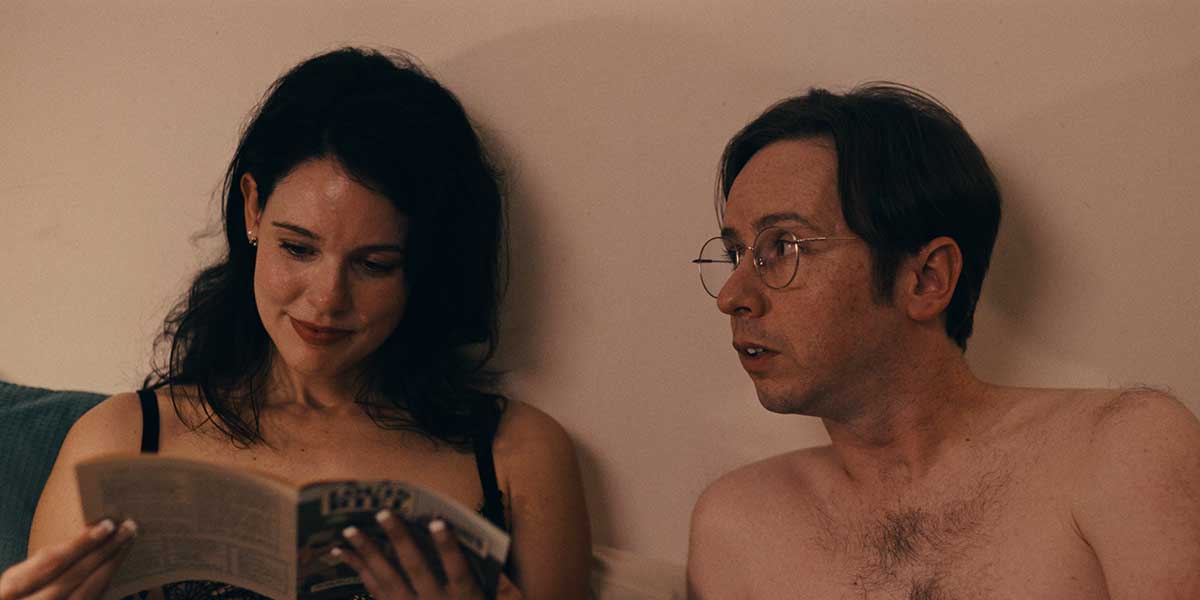
ELENA: Totally not intentional. I think it’s just that that show happened to cast queer people. There’s not that many. That’s what’s interesting. There are not droves of out queer performers, I think it just happened. Lea DeLaria, that character of Denise, I remember we still hadn’t cast that character and Lea had always been in my mind, bouncing around there. After Asia was attached and was very much invested in the project, we were having a conversation about Denise, we both looked at each other, I think we almost said it at the same time: “Lea DeLaria, isn’t it?” It just felt so natural and it’s interesting how much overlap — like Leah and Asia are both on Orange is the New Black, then Daniel, who plays Emil, Asia, and Louisa were all on Billions which is totally unintentional, it’s just how it happened in a weird way. The casting world is a small, small world.
AUGUST: You talked a little bit about how you wanted to set it in the Inner Richmond and how you moved to the Inner Richmond, which I love, and I was enjoying myself recognizing all the bits and pieces of my neighborhood. But you’re also really going through all of Clement, you’re going through all of Geary, and you’re on Taraval sometimes, you’re showcasing the parts of San Francisco that aren’t captured on film often. Was that something you set out to do or was that where you thought the characters should live?
ELENA: There’s a little bit of a geographic fudging because I wanted this sense that Cass lives far, far out, just how the Outer Richmond is. There’s this sense of a more residential space, with not a whole lot of shops and stuff, but then we did shoot a lot much further in on Clement. Those places and those streets very much have that aesthetic I was looking for. That donut shop on the corner of 10th and Clement, the diner, Hamburger Haven, and The Bitter End, these were a lot of places that I used to hang out in and knew very well. The whole time the movie was incubating, it felt like a movie of place, the way these certain places evoke certain emotional landscapes. Cass is both avoiding their past, but stuck in it. They still use a flip phone and we intentionally designed their apartment with a little bit of this retro feel, to show, in a way, they’re not growing up. There’s also this tender quality to the more analog world they’re drawn to. The whole idea of these places: laundromats, diners, libraries, the bank, they’re all very much examples of the physicality of the world that we more and more are moving away from. You can do all those things from home, including order your food, you don’t need to go out. There’s something about paying homage to place and to places, their physicality and the beauty of that.
AUGUST: The film itself is about queerness and transness, yet it’s not a film about their identity being the root of suffering, and a lot of their suffering does come from interpersonal relationships. There are a lot of dramas that try to pull at the heart strings and manipulate every single aspect of someone’s identity for pain, but this sets you in a world where the pains are from relationships [and not prejudice]. Was that something you were aware of wanting to subvert when you were writing it?
ELENA: I definitely was not interested in making a film that’s about being queer or trans. I knew it wasn’t about that, but it also feels like I definitely wanted to make a queer trans film. It’s just the world, it’s just who they are. The primary plot and story points don’t have anything to do with that, although it comes in and inflects things in certain ways. I didn’t want to ignore it either. It’s a bit like their economic situation. I didn’t want a film about the struggle to make it in capitalistic, gentrifying cities, but I also didn’t want to ignore that. I wanted that to be part of the realism of the movie, these little grace notes of their day to day that come in. The queerness, trans thing works the same way, the pronoun conversations that happen from time to time just contribute to that sense that there is a little bit of Cass — you sense they’re on the outside looking in, of the family that they nanny for or the beginning, going to this queer bar, this expensive queer night where the people are not quite like them and they feel a little like an outsider there. So it does come in and inflect things, but it wasn’t the primary interest of the movie.
AUGUST: Not to be crass, but you’re up for an Indie Spirit Award. Congratulations! How does it feel to get that larger recognition for a smaller independent film? Obviously, that’s what the show is for, but what did you feel when you heard the news and how does it feel knowing that more and more people are seeing the film?
ELENA: I was so honored and surprised and delighted, and I feel the fact that it’s awarding the writing, it really makes me appreciate and reflect on how much the writing, which has this illusion that it’s just about me sitting down and writing words, it’s all being received through the collaborations of all of these people, right? It’s not the script that’s winning an award. It’s the writing of the film. I’m not just saying this to sound a certain way, like more gracious than I am. I’m saying it because it’s so true that it’s recognizing and honoring everyone who was part of bringing the script to life. That’s really what I reflected on, and I’m just so delighted we got nominated and that it’ll bring more attention to the film because the main thing is I just want people to see it. It’s a tiny film in the scheme of things, and it’s a hard landscape to get people’s eyes on films like this, even though we’re now on Amazon and Apple TV, but we don’t have the resources where we can do big ad campaigns. The most meaningful part to me, other than getting to make the film itself and the creative joy of that, has been going to festivals and hearing audiences receive it, and particularly the people who come up and talk to us personally about how it landed with them or impacted them. I think everyone involved with film says it’s when you hear those comments, it’s all the blood, sweat, and tears that are involved in doing something, that’s what makes it worth it. To know that it’s touched someone or landed in a way that they feel less alone.