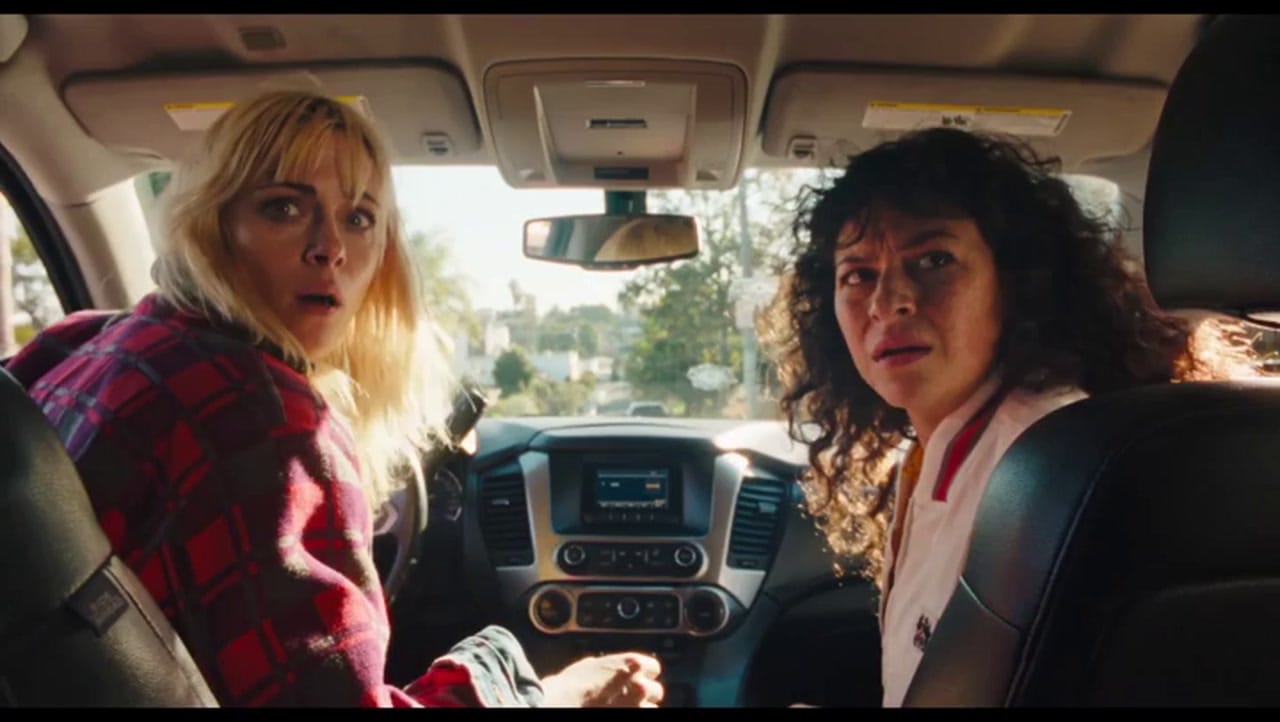
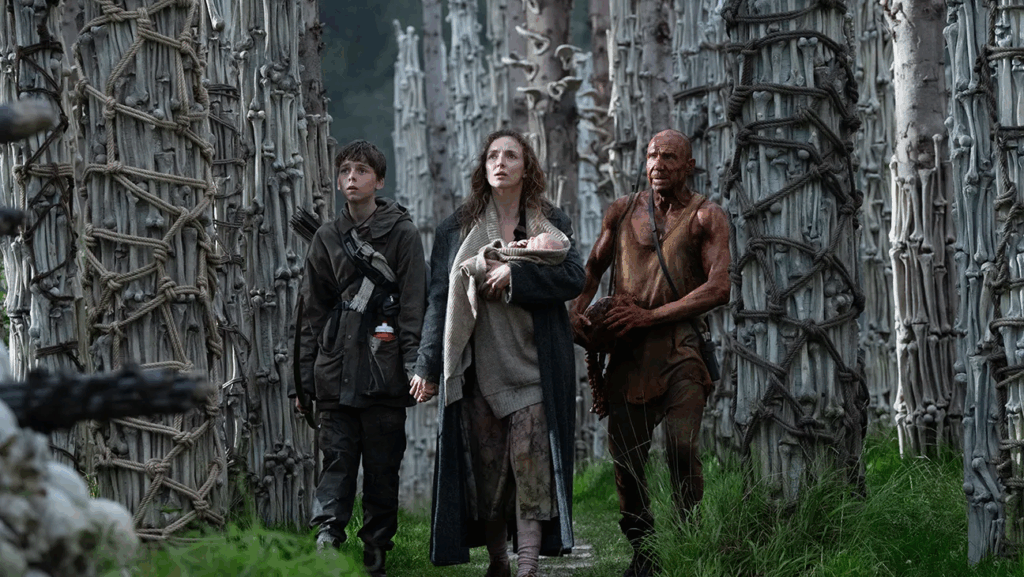
Around eighty minutes into 28 Years Later, Danny Boyle stops his action down to create a quiet, sort of riffed, ad-hoc pietà—a sick mother (Jodie Comer), her son Spike (Alfie Williams), and a baby all cradle one another, forming a quiet island of warmth and calm in the clanging storm of zombie violence swirling around them. While the image itself, like any pietà, has all this sincerity and heartbreak to it, in Boyle and his returning screenwriter, Alex Garland’s hands—it’s also proudly, almost sneeringly, bizarre. That baby’s the baby of a zombie, that son’s a zombie-killing kid from an isolated island on a quest to get his mother seen by a supposedly insane doctor in the woods, and that mother, in her illness, keeps mistaking her son for her own father. And that’s like, maybe the fifth wildest construction in the movie.
23 years after the release of 28 Days Later, Boyle and Garland are back in their director and screenwriter roles, respectively, for 28 Years Later. It’s a welcome return, as the film, for my money, is stranger and more idea-stuffed and, frankly, more exciting than either of its predecessors. While the Cillian Murphy-starring original still has its undeniable power—his character, Jim, walking through the deserted London streets remains this awful, singular piece of post-9/11 “what the hell happened here?” urban horror imagery today. But the sequel, 28 Weeks Later, subbed Juan Carlos Fresnadillo in for Boyle, and the result, while fun, was more of a down-the-middle action/horror programmer than the first. With their return, Boyle and Garland make the most out of the larger canvas the years away gave them to work with. Here, they weave post-Brexit and Covid-era isolationism, a Heart of Darkness-style “lone man going to seed in the jungle” character study, macabre folk art, and, in the film’s (somehow) wildest twist, Teenage-Mutant-Ninja-Turtles-meets-The-Warriors inflected street gang culture, together, forming this strange, singular whole.
Following a nasty, nihilistic little cold open in which a family and (crucially, most of) a gaggle of children are torn apart by zombies, we jump 28 years ahead. There, we’re introduced to twelve-year-old Spike, just as he’s about to set out from the heavily-fortified island he lives on with his father, Jamie (Aaron Taylor-Johnson), and his sick mother, Isla (Comer), for the mainland. The purpose of Jamie and Spike’s trip only becomes clear once they’re in the thick of killing zombies—this far on from the events of the first film, Britain, Ireland, and Scotland have all been completely quarantined from the rest of the world, the uninfected survivors left to contend with the zombie outbreak on their own. What’s grown up in the wake of that isolation are security-obsessed villages of the uninfected, handfuls of whom regularly venture to the mainland to kill zombies, track down resources, and generally maintain what culture they can in the face of… all of the zombies.
When Spike and his father narrowly escape death—they just skirt getting killed by an “alpha,” which is a new, much-harder-to-defeat type of zombie—Spike ends up completely disillusioned by the one-two-punch of witnessing Jamie stepping out on his mother at their “welcome back, congratulations on not becoming zombies” celebration and his exaggerations about how they both handled themselves on the mainland. Not content to leave Isla to wrestle with her illness on her own, and newly armed with the knowledge that there’s a doctor living somewhere among the zombies, Spike sets out to get Isla the treatment he hopes will save her. What follows is marked both by the kinetic, jump-cut-heavy frantic visuals Boyle brought to the likes of 127 Hours and Trance, albeit, funnily, tempered with the earnest, great-with-kids hand he also brought to Millions and the early sections of Slumdog Millionaire.
When Spike finally finds Dr. Ian Kelson (Ralph Fiennes), Boyle and Garland shift into yet another gear. Kelson, while maybe not completely “insane,” as Jamie’s dad characterizes him, is definitely working and living on his own wavelength. He constantly wears iodine—which, we’re told, helps shield him from the zombies—giving his skin this smudgy, orangey stained quality, and works on a sort of Watts-Towers-meets-the-Sedlec-Ossuary project of arranging the bones of the dead into an elaborate memento mori. Kelson examines Isla, and after determining that her illness is, in fact, a cancer he can do nothing for, he gently, humanely kills her, removes the flesh from her body, and gives Spike her skull to place in a prime position on his skull tower. Spike climbs to the tower’s peak, kisses Isla’s skull, and positions it so he and his mother can watch the sun rise for one last time, together—which, if you’re keeping track, is probably the third wildest thing that happens in the film. Maybe the second.
That Boyle and Garland manage to pry some genuine emotion from a piece of plotting that’s as on-its-face-gruesome as that one is testament to just how gonzo their vision for 28 Years Later is. And that they’re not done ratcheting their gonzo vision up is, for me, what makes the whole thing such an exciting, fun piece of work. In the actual wildest beat of the film, they ultimately wrap everything up by bringing back one of the child survivors of the zombie attack from the cold open. Now aged 28 years, that kid, Jimmy (Jack O’Connell), it turns out, has managed to not only make his way on the mainland, living among the infected, he’s also done so with a whole crew of velvet-track-suit wearing, streetwise zombie killers. Jimmy and his crew jump in to save Spike from certain zombie death, tearing the advancing horde apart with a goofy, hand-to-hand combat style that completely zags from the tone of the movie that preceded it. It’s a big swing, and if it’s not to your taste, I totally get it. But that Boyle and Garland ultimately close their ode to mothers and sons trying to survive the worst social collapse imaginable in this particular way, for me, speaks to there being a lot of life left in the 28 Days Later premise.