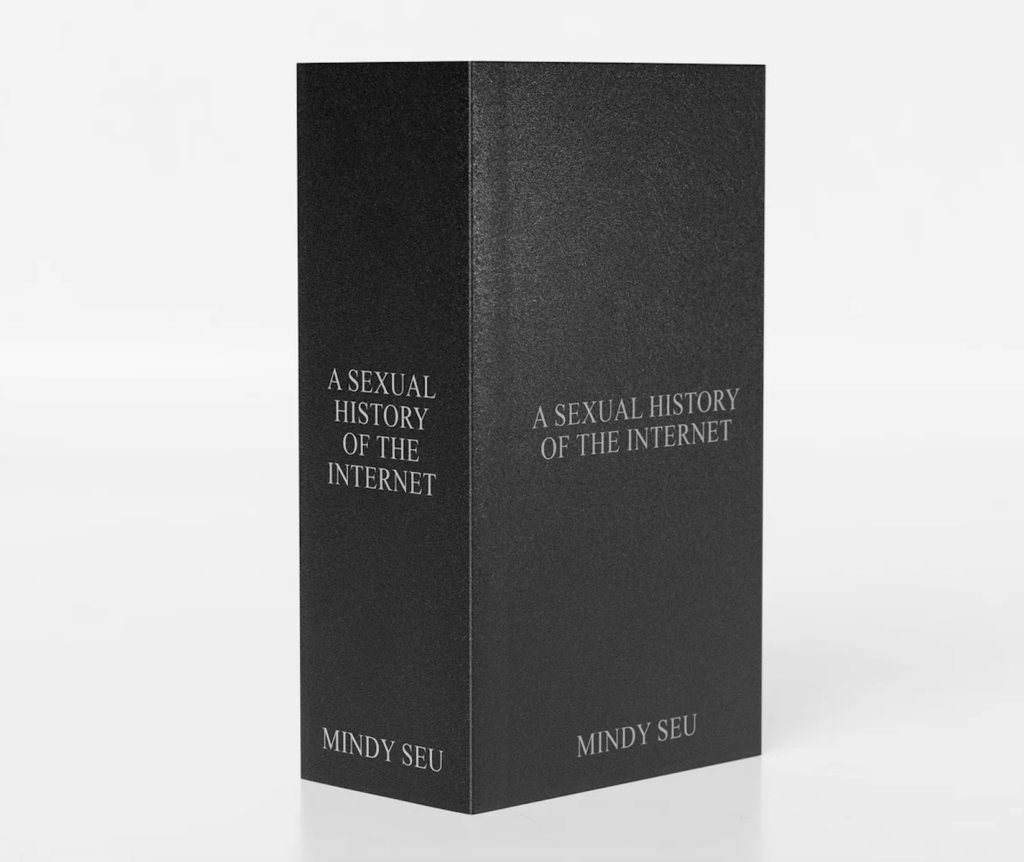
For more information about Mindy Seu’s fabulous lecture series and book, “A Sexual History of the Internet”, please visit https://asexualhistoryoftheinternet.com/
To engage with Mindy Seu’s performance lecture “A Sexual History of the Internet”, you must have an Instagram — perhaps the app which most embodies the hypocrisy and cynicism held by corporate social media giants toward sex. It’s a site buoyed by brandable images of bodies — often sex workers promoting their work — that also capriciously censors sexuality it deems too blatant. As the book iteration of Seu’s lecture (also titled “A Sexual History of the Internet”) notes, “Some sexuality is amplified by the algorithm while others are erased”.
Much like the sex workers who use modern social media for promotion, “A Sexual History of the Internet” adapted by necessity to survive the virtual space it exists in. Words like “sex” and “fucking” are censored with asterisks. Videos selected by Seu are cut off or altered in an attempt to satisfy Instagram’s finicky bans on nudity.
Seu’s performance centers on a collection of curated Instagram stories clicked through in unison by the audience on their individual phones. Physically, the lecture occurs in a shared space. While audience members tap their screens, Seu narrates the text onscreen. Some passages are read aloud by the audience in assigned groups. The act of reading in unison connects the individual to others in the room, and can sound almost prayer-like in intonation. But it also emphasizes our difference in digital experience. Even a best-faith attempt to start all the Instagram stories at the exact same time results in an asynchronous audience experience, due to accidental clicks or digital lags. We are experiencing the same images and internalizing the same information, but each with our own slight subjectivity.
This is due to no fault of Seu’s, whose instructions are hyperspecific. She articulates what Instagram account to follow, where to find stories, the way to place your iPhone on Do Not Disturb by pulling your menu down from your right hand corner. In setting up the conditions for this performance to work, our phone is renegotiated as something new; movements I’ve performed many times unthinkingly now no longer feel instinctual. It’s apt, then, that the first chapter of Seu’s lecture centers on the tangible aspects of the technology we use. Seu starts with an exploration into “teledildonics” (her explanation and analysis is reason enough to go to the lecture and/or purchase the book, and I won’t botch it here): the phone as sex toy, the computer mouse as vulva, the language we use when we talk about computerization (most obviously, “jacking in”).
Seu’s work is a masterclass in archive, research, and presentation. She takes a landscape vast and integral to our current lives and crafts an arc centered mainly upon key, but often obscured, historical and cultural figures. She crafts an analysis of Alexander Skene’s and J. Marion Sim’s violating “gynecological experiments on enslaved women without anesthesia”, research that made them the “fathers of gynecology” while we know only the first names of three of the women experimented upon: Anarcha, Lucy, and Betsey. This historical backdrop brings depth to her analysis of sex workers’ essential contributions to creating the Internet as we know it, sometimes willingly and sometimes without consent — from the utilization of their nude images to develop the .JPEG to their groundbreaking work in creating individual webpages. And yet their contributions are constantly cast aside, and their very existence online becomes increasingly litigated by greedy, censorship-oriented platforms and governmental systems that work to oust them from the spaces they created (or at least, attempt to — the sex work community proves to be constantly and aspirationally adaptable, resilient, and determined).
I realize as I write that I have been speaking of “The Sexual History of the Internet” by naming only Seu (who deserves many accolades for the artifact she has created). But this work, like any truly meaningful archival practice, is not just potent because of the many voices and materials included, but because of how each of these contributions is so cherished.
The Instagram stories that “A Sexual History of the Internet” comprise are available in book form, in no small part because a tangible archive of this lecture is essential when Instagram can rid of much of the digitized performance content on a whim. The book’s profits are going to be divided evenly amongst each author, artist, or voice behind each contribution.
“A Sexual History of the Internet” uplifts these voices that both commingle and differentiate in their interactions with the Internet and/or sexuality. They all sit in the same world, interact with the same objects, float in the same digital space. But much like the voices stumbling over the captions in imprecise togetherness throughout the lecture, there are endless differentiations, both miniscule and massive, to each subjective interaction with a concept so gargantuan.