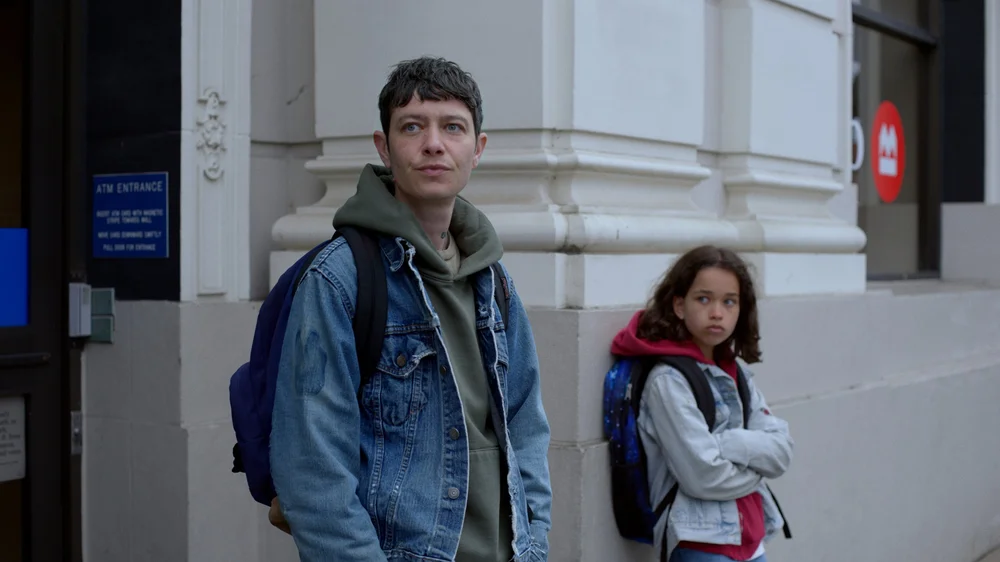
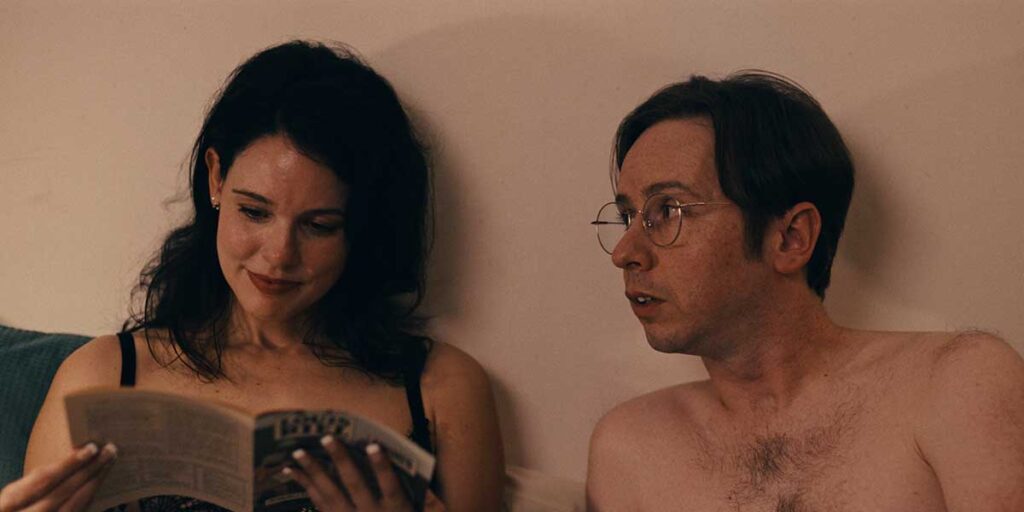
After premiering at TIFF in 2024, director Sook-Yin Lee’s adaptation of Chester Brown’s iconic graphic novel Paying For It is finally making its way to the US. High Femme had the pleasure of talking with Sook-Yin Lee about adapting such a dense, personal, and complex text, her artistic inspirations, and reinserting herself into a story that originally kept her identity discreet.
This interview has been edited for clarity.
VERONICA: I was reading in another interview that you felt the film adaptation of Paying For It was an opportunity to get more of a sex worker perspective within the story, because the original iteration is so invested in Chester’s interiority. You chose to more meaningfully incorporate your perspective and portion of the story, as well. How did you balance between the adaptational and the autobiographical?
SOOK-YIN: I spent the greater part of several years serving the graphic novel as it is. The first iteration is a direct transcription [of the comic] and Chester and I were like, “This is terrible.” We very quickly realized that a comic book is not a movie. His work is a very political polemic, and very episodic, which doesn’t really work in movies. Usually movies have three-act structures and character transformations and what not. So I was really trying to crack that nut. The last fifth of the book is his appendices, full of intellectual and historic ideas and notes, with no pictures, on the topic [of sex work]. There was one iteration where I did have him on a pulpit ranting all his notes. It was cute, and it would have worked maybe if you were Godard in France in the 60s, but today it just didn’t work. It wasn’t until I was reading the book for the umpteenth time that I saw that he had seen a sex worker on my birthday. I had a pang of jealousy, I was like, “What?! That was my day! You were seeing someone else?!” […]
Chester and I were going out for a long time, and are still each other’s families. [At the time] a lot of young people were having open relationships. […] I had just moved to Toronto to be a VJ on MuchMusic. I was living a very extroverted life: interviewing celebrities, going out to concerts, playing shows. I’d drag Chester to a concert and he’d be in a corner reading a book. Our interests were drifting. And I’d developed a crush on someone. It was weird because I’d never had a crush on someone outside of a relationship before. I knew I didn’t want to lie to or cheat on Chester, so I brought it up with him. Chester is a very freedom-loving person, and that extends to the freedom of his friends and his loved ones. He’d never try to control or constrain or put boundaries or anyone, he just listens to what people want to say and do, so long as they’re not hurting anyone. So he agreed to try [an open relationship]. I started perilously dating, and he was celibate for a long time, and then he started to investigate paying for sex, which became the inspiring experience of his graphic novel, Paying For It.
He was focused upon what he had observed, which was a lack of rights for sex workers that put them in harm’s way. […] At the moment when I realized he had seen a sex worker on my birthday, I was like, “Oh right! We were living together in this tiny rowhouse for years after that, navigating our own relationship with one another and choosing to go on our own separate missions and adventures and misadventures.” So I thought if I expand the canvas of this book, if I add all this stuff that was going on in our relationship, it could be the only way to make it work.
And in that way I was also able to distill those appendix notes to the things that were interesting to me or stuck with me — the main ones were the parallel he draws between the fight for sex worker’s rights and queer liberation. In the 80s if you were a guy in Canada and went to a bathhouse with other guys, police would come in, raid the bathhouse, and arrest everybody. We’ve come a long way since then — there’s gay marriage, there’s many more LGBTQ+ rights, but they are now once again in peril and being stripped. […]
I sorta distilled what stuck with me, which was the argument for queer liberation and sex worker’s rights and worker’s rights equals human rights. I also was questioning possessive romantic monogamy, which is the kind of relationship that most of us abide by. I go out with you, you go out with me, I have sex with you, you only have sex with me, ‘til death do us part if I put on a ring. So Chester, being a pretty pragmatic person, was like “Is possessive monogamy really that loving?” […] I was trying to be all cool when he told me when he was seeing sex workers. I was a kind of Riot Grrrl that grew up in the Vancouver underground. So outside I was like, “Cool, yeah.” and inside I was like, “OH MY GOD! I’m gonna lose him! I’m jealous!” So it really took a lot of conversations to undo my own ignorance. I knew if I incorporated our relationship [into Paying For It] I could address all those ideas. Without being didactic! I didn’t want to have a political track like Chester. We’re very different people. He’s very logical, cool, and very funny. I’m hot-headed and emotional. This movie reflects both of us, it’s a real double-act of portraiture. So yeah, the politics are very important to me but, you know… I had a friend, Laurent Cantet, who passed away, and was a great French filmmaker who did The Class, and does a lot of incredible political films, but you can’t really tell they are off the top! And I hung out with him and asked him how he did that, and he said, “You always know what you want to ask and put out there, but my job as the filmmaker is to obscure the footprints.” The last thing I want to do is tell people what to think. People are smart. What I want to do is ask questions and tell a funny and human story — a difficult, challenging, emotional, and entertaining story.
VERONICA: It’s interesting what you said about concealing the footprints, because I notice you have these moments with these sex workers — some of them are so fleeting they’re almost vignettes. What I love is that I’m never receiving a political footprint or a trope, but a full-bodied person. What was your process in writing these moments, but also accessing these performances in what I imagine is very little shooting time?
SOOK-YIN: I mean we had nineteen days to shoot the whole thing, so I really had to build it all from the ground up. I had a shot list, I knew I wanted to lean into Chester’s tableau style and I was really interested in Taiwanese New Wave, the work of Edward Yang. I was also really interested in Leos Carax’s first film. I knew that I didn’t have very many set-ups so I would have to do a lot of oners. This is very demanding for the actors, but it’s very compelling if they can actually do the entire scene with the camera following them.
I was also casting locations like I would actors. I shot in my eleven-foot wide rowhouse, where I am today. I found brothels who would let me in. I knocked on a lot of doors and many of them said, “No!” I ended up having a great conversation about cinema [at one brothel] and they were big cinephiles who said, “Okay you can use this place, we’ll take the day off.” […] I also went about finding places in my neighborhood, Kensington Market, that were era-specific and still seemed late ‘90s. So restaurants that have been around since the ‘90s, art galleries. I was just making sure all the details were correct, and that extended to the music videos [playing on MuchMusic]. I’m a musician and I leaned on my intergenerational peers from across Canada who had amazing videos and music. […]
I think there’s something in the specificity that is gleaned from writing about real life, because most movies are binary or reductive. They play into tropes or archetypes. This is fine, all stories are archetypes. But if you can glean details from everyone’s exceptional life, you can really add sparkle and spice. People either go, “Oh my god, did that really happen?” or “Oh my God, I do that, too.” The specific becomes universal. […] I talked to Chester and was like, “You know movies are about people who make decisions, who are flawed, who undergo transformations.” And Chester was like, “I have no flaws.” I said, “Boo, that’s a flaw, I’m writing that down.” […]
The casting of all the sex worker roles, I knew people I wanted to work with who are part of my community. Every single one had a nuanced understanding of sex work. […] I’ve done sex work adjacent work but I’ve never done sex work, so I had to go and speak with people who do the work and understand it better. Valerie Scott is someone I really leaned on, and she’s a long-time sex worker’s rights advocate and told me all sorts of very interesting details about the work, long-term customer relationships, and the challenges.
VERONICA: Do you have any specific Canadian cinematic reference points you were working with?
SOOK-YIN: Definitely Chester and the spirit of comics. I don’t know if people know, but Canadians are at the forefront of independent, underground comics. […] I didn’t want to make a nostalgic movie about the ‘90s even though it’s set in the ‘90s, I wanted to make a movie about something that felt important today. My character works at MuchMusic, or Canada’s MTV. When I worked there I had free reign to do all kinds of bizarre social experiments, but as the company became more corporate, so did the content. Eventually I was asked to interview DJs for the Colgate DJ Challenge. It was a similar arc to comics, in that at first it was scrappy zine culture and then it became this bloated, steroid, superhero Comic-Con world. […] Also, getting back to the sex work authenticity element, Andrea Werhun plays Denise. Andrea and Chester have a longtime creative relationship. He was an actor in her short film Modern Whore and did the poster for it, so it was a natural fit to cast Andrea. She as well as Chester would read later iterations of the script to make sure that all my is were dotted and all my ts were crossed. […] This movie is very much a grassroots operation, I’ve been taking it around like a touring band. We’ve been having these intense and hilarious Q&A’s after that basically turn into town halls, because everyone wants to talk about this stuff.
HIGH FEMME RAPID-FIRE QUESTIONS:
HF:What’s your biggest time suck online?
SYL: Really trashy crime stuff.
HF: Favorite curse word?
SYL: Fuck.
HF: Favorite perverted thing (it can be art, an object, a person, a sex act, whatever)?
SYL: Having fun with furniture! Specifically walls!
HF: A sex discourse you wish you could ban?
SYL:Anything that’s too eggheady.
HF: Favorite book from childhood?
SYL: Harry the Dirty Dog.
HF: Song of the spring?
SYL: I’ve been listening to Meara O’Reilly.
HF: Do you call it a journal or a diary?
SYL: Journal.
HF: Person dead or alive that you would ask to dinner with the sole purpose of getting to throw a drink in their face?
SYL: Walt Disney.
HF: Ideal nap length?
SYL: Five minutes can feel like an eternity… But I would say an hour.
HF: Best time to write?
SYL: I’m a night owl.
HF: Worst place to edit writing?
SYL: In bed on my phone. It really makes my neck hurt.
HF: Any opinion on any movie ever?
SYL: In It’s A Wonderful Life Jimmy Stewart has all these big plans but then his dad dies and he’s saddled with staying at home. That’s a weird message. You have to explore your desires, wants, and needs.