Sophy Romvari’s feature debut, Blue Heron, is going to be hard to beat as one of my favorite films of the year. A partially autofictional film, Blue Heron is about family, childhood, memory, loss, and the desire to understand (and perhaps even wish to change) that which is unchangeable. It’s also one of the most intentionally directed films I have seen in a long time. Everything is purposeful, thoughtful, and considered; Romvari’s reverence for the mediums she interacts with (not just cinema, but photography, and perhaps even the very practice of visual documentation itself) is infused in every moment.
I was delighted to talk to Romvari about memory, archive, and just a few of the numerous skillful, deliberate, finely-tuned choices that make Blue Heron so remarkable.
VERONICA: I’d love to talk first and foremost about the different modes of documentation referenced in Blue Heron. There’s a dense mix of still photos, tape recordings, iPhone camera videos, Zoom calls. What do you consider Blue Heron’s relationship with documentation and memory to be?
SOPHY: I have a very strong connection to media and memory both in my life and in my work. I have always been drawn towards showing characters or myself reflecting on media and having those things be almost supplementary to memory. So much of my memories are muddled between memory and reflection through media; looking through old photographs, looking at videos, and those sort of supplanting themselves as memory. It’s hard to know where they start and where they end — the memory versus having the memory refreshed because you’re seeing a documentation of something. I think I have a high level of experience with that because my dad was such an avid documenter, archivist. He basically was documenting my entire childhood from a very artistic lens and perspective because that’s where he chose to put his artistic practice. I have this pretty extensive archive of my life, and so very naturally it made its way into my work… The photography, the concept of home video footage. I think it’s the way I’ve been able to piece things together throughout my life, and so I’ve always been inserting those things into my work as a mode for characters to uncover things from their past. I think there’s been a long history of this in film, you know, archives within film, media within film, and I’m also really a screens within screens kind of filmmaker. I don’t shy away from iPhones and laptops, I incorporate those kinds of communications because I find them to be very realistic to the way we communicate in the contemporary world.
VERONICA: Did you feel there was one mode of documentation that was more personally connective in the way it evoked memory than others? I wonder if you feel a difference in the amount of intention in the way in which we now archive and document.
SOPHY: I do think about that a lot. I made a short film called Still Processing which is a short documentary that interrogates what the difference is between the still image and the moving image and how it affects our memories. I think the still image, the photograph, evokes a very different emotional response than a video does. Because the video gives this aliveness even if it’s something from a long time ago. It tricks you into feeling like something is present. The photographic image has a much more morbid sense to it, I feel. It’ll be interesting to see how we reflect on this period of time in terms of nostalgia, and how documentation will evolve with technology. Especially with there now being a sense of distrust with the way that photographs are taken because of AI and even manipulation. There’s now a sense of technological intervention that didn’t necessarily impact us with the nostalgia we’re trying to depict in this film. I think a lot of younger people who watch the film do have a sense of nostalgia even if they didn’t grow up with the same media, because there’s this desire to have had access to something which was less mediated through social media and these different forms of perfectionism.
VERONICA: There is something, I feel, about the way it used to take more effort to create with and on film, but simultaneously you had less of a guarantee in the quality of the content — to speak to your thought on modern perfectionism — and so these older modes can feel more authentic (even if it isn’t necessarily true) and can impart a sense of seriousness.
SOPHY: Totally, and I think that’s even true from the 2010s to now. We joke about it but we used to be much less curated even in early social media iterations. Uploading photos to Facebook albums was the last sort of uncurated, very sloppy documentation. Now people are afraid to even post photos on the grid because it’s too permanent, or something. There’s a sort of vulnerability that comes with posting now that didn’t used to be there. Especially for teenagers, I can’t even imagine the sense of self-curation and image obsession of how you’re being perceived. These are things we didn’t necessarily grow up with and it plays a big role in how media is consumed, as well.
VERONICA: Absolutely. I’m going to pivot a little bit because I’d love to talk about the part that nature plays in your film. There’s so much time spent outside in this film. I feel like you have such control over your frame and your camera. I’m curious about the experience of interacting with something as variable as the outdoors. Was there any specific intention with how you wanted to capture those scenes? Were there any challenges you weren’t expecting?
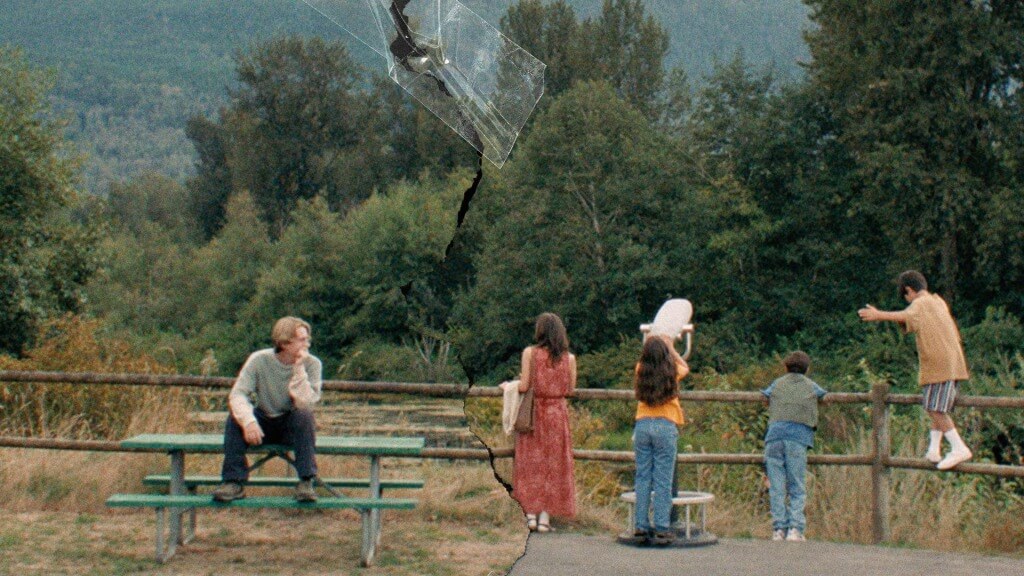
SOPHY: It’s a very unique location and geography, Vancouver Island, where we shot most of the outdoor sequences. During preproduction for the film we went to Vancouver Island, myself, my cinematographer Maya [Bankovic], producer Ryan [Bobkin], and our focus-puller Chris Merrell. We spent two days location scouting, but also camera testing. We brought the camera that we intended to shoot on. We went to the mountain where the film opens, we went to the beach, we went to all of these outdoor locations to capture footage and see what kind of textures and aesthetics we could get with the lenses we were trying out. It really helped with the planning of the overall aesthetic of the film, because it was such a vivid location and such a touchpoint for the rest of the film and how it feels — the blues, the greens are so incredibly specific and lifelike. We ended up actually using some of the footage that we shot during the camera test in the film, like some of the B-roll footage of the beach itself because it was such a beautiful sunny day. And Vancouver Island, because it’s not as populated as, say, Vancouver, there’s more of an opportunity to shoot these landscapes without other people being around, which was such a privilege. These landscapes are so integral to the language of the film and the feeling of isolation and the feeling of past, somehow. I always think of Vancouver Island as a little bit behind the times. It’s like because of the distance of Vancouver Island from Vancouver there’s a bit of a sheltered nature to the island.
VERONICA: It’s so interesting what you’re saying about the remote nature of the island, because I was thinking last night that there is this sense of a familial unit forming partially because of the fact there’s very few people around them. There are these references sometimes to the fact that Sasha’s family is beginning to self-isolate, but simultaneously sometimes they’re out in places where there could be other people and there aren’t people. There’s a lot in this movie that is unspoken, there’s a lot of silence and observation, and yet you have this feeling of a familial unit and a growing understanding of where the fractures are and where the connections are. How did you go about collaborating with your performers to create that energy, especially when so much of it has to come from physical proximity and observation as opposed to speaking to the connection or the fractures within it?
SOPHY: That’s a great question. To speak to the locations not having other people, that was quite intentional. I wanted these moments to feel curated in the sense that these are intentional memories that we’re being given access to. It didn’t make sense to me to have someone walking through the background of a shot. That felt, to me, antithetical to the concept of memory, and it felt like something… If you’re looking at the film as a depiction of the film that Sasha makes later in her life, you can think of it as memory or as part of her own work. Why would she put extras in the back of these shots? It made sense to me not to have incidental moments, like everything is so precise. To speak to atmosphere and performances, so much of that was about creating a lot of natural chemistry between the performers by having them spend a lot of time together and building trust between them. Most of the work I did with the kids was about building their relationships. Especially with the two young boys, all the prep I did with them was sending them off to have playdates and to get to know each other. I didn’t incorporate Edik [Beddoes], who plays Jeremy, into the family unit until much later because I wanted him to feel a little bit distant. But then he did spend time with the actors who played the mother and father so he built a relationship with them but was a bit more distant from the siblings. So much of it is just a natural sense of familiarity and trying to create atmosphere through how the set was run, and having it be a really safe and natural environment for this family to inhabit.
VERONICA: I feel that this movie is so well-observed. I have a pet peeve regarding some films short-cutting or fudging how children behave in a way that’s inaccurate or is an adult idea of how children behave. What I love so much about your film is that it’s an accurate observation of how children exist in the world. Was there a process for finding that with your performers? Were you tailoring the work to them?
SOPHY: Some of the moments were quite literally pulled from home video footage, to be honest. The moment when the little boys are playing with the paper boats in the sink was something that I did see in a home video clip. One of the boys actually knew how to make the boats, so instead of scripting that moment I said, “Can you teach him [the other boy] how to make the boat?” So we set them up with some of the tools and then we just documented that. […] And then the scene in the darkroom that takes place downstairs was shot in real time. We actually had an active darkroom with a real photochemical process, and then we had a photographer come in — who shoots all in black-and-white stills — and teach the kids how to develop photographs. We documented that whole process, [because] I essentially wanted them to have that experience of that wonder of seeing a photograph come to life in front of their eyes. So I was leaving room for things to be documented as if in a documentary, but curating them within a fictional landscape. I wanted to make it as real as possible with them so they could just bring themselves to the story and the film.
VERONICA: I’d love to talk about your utilization of color in this movie, because it’s spectacular. I was so struck by the shot of Sasha standing between the purple robe and flowers when she’s leaning against the door. Moments like that look almost like a painting to me. How did you go about envisioning and executing this specific palette?
SOPHY: So much of that was a collaboration with my production designer and my costume designer. Victoria [Furuya], who did the production design, is a very talented Ikebana artist, she works with flowers and does experimental flower installations, so she’s really focused on color, texture, and evoking something through natural materials. There’s quite a bit of floral in the film that came from her specific crossover in her work experience. She was also really focused on material accuracy like what plastics were common, what colors were the most popular, how we can incorporate things that are clearly thrifted and hand-me-downs and from periods past. Especially with the costume design, Maria [Katarina’s] approach was to ask, “How would this family dress given their economic position, their immigrant status, the period of time, the fact that they lived in the Pacific Northwest?” These greens and teals are very specific to that geographical location at that time and at the time leading up to it. The production designer and costume designer were very collaborative in terms of palette. And it makes a big difference because it creates this very cohesive world, and you’re not being taken out of it by something that’s like screaming at you.
VERONICA: When I first saw your film at TIFF, I remember you saying you were reading Cassavettes on Cassavettes while directing your film. Were there any other artistic touchstones of any medium that you found yourself returning to while shooting this?
SOPHY: Probably the most common would be photography. I think Maya, our cinematographer, has such a naturalistic eye towards capturing human faces, and that was really important to this film because we were really inspired by my dad’s photography. Considering how to film a human face without it feeling intrusive but still feeling intimate was a big part of our process. We achieved that, I think, through having the camera at a distance and shooting on this long lens so you have the intimacy without forcing the camera within proximity to the actor. We could create this sense of closeness without having to be physically close to the actor. I think that does give quite an intimate sense of a person. We also were focusing on things like hands and other gestures that are not facial.
*
Blue Heron is now playing in select theaters. To find out if it’s screening near you, check out the link here. Sophy Romvari’s short films, including Still Processing, are currently streaming on The Criterion Channel.
You can read Veronica Phillips’ original review of Blue Heron here.