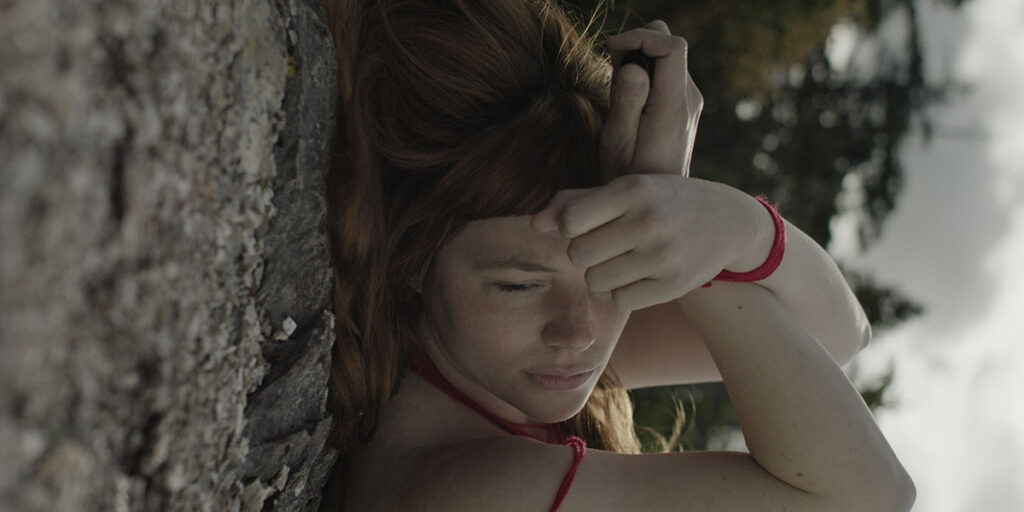
Time and again in Melanie Oates’ Sweet Angel Baby, the restless alabaster arms of the Atlantic Ocean grasp at the rich coast of a small fishing town in St. John’s, Newfoundland. As the white, frothy surf washes away, it leaves some of itself in the stubborn tributaries carved in the dark rocks, lively blood in ancient veins. The image is punctuative, serving in turn as a beautiful, erotic, heartbreaking, or prophetic pause. The veins wouldn’t be there without the unruly water; but they wouldn’t be there without the land, either.
Sweet Angel Baby is about Eliza (a strong, molten, and simply incandescent Michaela Kurimsky), a woman in her late twenties who has made the active choice to remain in the demurely religious coastal town she grew up in. It’s near pastoral, Eliza’s life — she lives in a warm cottage that overlooks the coarse, windswept coast, shares firewood with her neighbour, and walks to her parents’ to collect homemade bread. She works as a waitress at a fish and chips restaurant, diligently goes to church with her grandmother, and is nurturing a budding relationship with recent transplant-from-the-city Toni (Elle-Máijá Tailfeathers).
When the church is bought by real estate developers, Eliza spearheads an ambitious fundraising initiative that hopes to buy it back. As the little town attempts to withstand the winds of modernity, Eliza finds her safety, relationships, and world threatened when she is doxxed by a man in town — she has been posting beautiful portraits of herself in various stages of undress anonymously to Instagram, finding immense success.
In Eliza, Oates paints a delicate portrait of what it looks like to stay true to oneself, to one’s choices, to one’s art, amidst the churning waves of change and growth. The film is as much the town’s story as it is Eliza’s, for Oates has the community reckon with its sleepy acts of misogyny, homophobia, and religious intolerance. Sweet Angel Baby’s greatest gift is its softness and space, for even as cruelty is hurled against Eliza, and the woman is nudged with increasing force toward a loud reclamation of her authenticity, Oates takes care of her, all without passing moral judgement against the townsfolk.
At one point in the film, Eliza falters under the weight of the town’s gaze and deletes her Instagram account, but this isn’t where her story ends. Finding strength in Toni’s care and love, in the community that stands by her, Eliza ends the film standing tall on the craggy rocks of the shore, against which the ebullient Atlantic triumphantly crashes, taking portraits of herself with her face no longer veiled by her long red hair. The film ends with Eliza proud of who she has become.
This is a film of understanding and immense tenderness. It is about community inasmuch as it is about Eliza, showing us that we carry the worlds that we are a part of, that they move us or come out of us when and as we create and love.
High Femme was lucky enough to speak with Oates about her stunning sophomore feature.
ALISHA: Where was Sweet Angel Baby conceived? Where did it begin?
MELANIE: I started writing it in 2014, so quite a while before we shot it. And the idea came from two different threads. The first was a bit more literal: I vaguely knew somebody who had a similar sort of Instagram account, where she was posting these incredible self portraits while living in such a small place. I was just fascinated by the idea of knowing that so many people knew this about her — she would just sort of walk about the world and her life — and how that must have impacted her reactions with people in the community. That I just found really interesting: the urge to do it, but also the boldness to do it. It =fascinated me because that was not something that I would have ever been able to do.
And then the other sort of more personal thread came from being from a small town similar to Eliza. In my early twenties when I first started writing and publishing fiction, just locally on websites and stuff, I received a very intense reaction to stories that I wrote from people in the place where I grew up. The stories were often about a young woman not dissimilar to myself, who was dealing with mental health issues or drinking or doing drugs or having sort of self-destructive sex. And so it was this idea that I was almost deviant or tainted in their view that affected my relationship to people whenever I went home.
ALISHA: This is a story about Eliza, but it’s also a story about a town and a community at the precipice of growth. Why was it important for you to tell Eliza’s story alongside that communal story?
MELANIE: It was always a really important element to me because when you do live in such a small place, it’s isolated. And so being part of the community is sort of a survival necessity. If you’re not part of the community, then there’s resources that you’re lacking or safety that you’re lacking, and there aren’t a lot of other options. And so for [Eliza], I really do think that she genuinely cares about and loves the people in her community, but it’s also that she needs them, too. And I really wanted to show how these sort of oppressive mindsets not only impact Eliza, but also the people in the town, because it can’t just be one or the other. There’s what they might be struggling with or parts of their identity that might be hidden. I wanted to show the underbelly of it, the dark side, but also the beautiful elements of it.
ALISHA: What struck me when I first watched it, and then again as I watched it recently, is that you don’t seem to pass negative judgment on the town, even as the herd mentality kicks in at one point. There’s such a tenderness and kindness and understanding toward the townspeople. I feel like it could be easy to feel mean and hateful toward these people who are being mean to Eliza. Was it ever hard for you? Did you ever feel feelings of anger in writing those moments, like the hate crimes that Toni and Eliza separately experience?
MELANIE: That’s a good question, thank you. Yeah, I feel like it was always important to me to show not only Eliza, but also the people of the town as objectively as possible. Obviously, I’m aligned with Eliza in a lot of ways, but I wanted to be as objective as possible and allow people to interpret them based on their experience or their beliefs. And I’m just generally not interested in black and white characters or morals. Finding those gray areas is what I’m really interested in exploring.
ALISHA: And a little bit on that note — the town is experiencing the grasp of modernity. I was wondering, especially with regards to the theme of the Internet in the film, was the approach of modernity a theme for you consciously when you were working on the film?
MELANIE: Yeah, definitely. I mean, I moved away from the small town I grew up in when I was 18, and that was really just before social media became what it is now.. So I find it really interesting to think about every kid having the Internet in their pocket and how that makes everywhere a global town. It’s like you are isolated but you’re not isolated. You’re getting the same content and information that kids in Toronto or New York are, and it definitely shows up in their clothes or makeup, and the music that they listen to and everything. The world plugs in in a new way that it didn’t when I grew up. So that was really interesting to me. I mean in terms of its influence, but also with Eliza, it allows her to express herself in the way that she does.
ALISHA: I’ve always seen Eliza’s photographs as her art, her creativity flourishing, and it’s such a beautiful thing. I love that you let her keep creating at the film’s end. It’s hard to keep creating when terrible things are happening to you. The question arises of how to keep true to yourself and your art. Why was it important for you to have Eliza continue to take her photographs at the end?
MELANIE: That was super important to me, especially because her and Tony arrive at this place in the relationship at the end where they’re together and now people know [everything about Eliza] and she’s at least starting the process of being able to accept herself and allow the world, the community, to see that side of herself, even if it means losing some people. And yeah, it was important to me that in doing that she didn’t lose her art practice, that she was able to have both, and that if she did lose this ability to express herself, then there would be something inherent to her, something fundamental, that was lost. I wanted it to feel hopeful for her at the end.
ALISHA: I think I would be remiss if I didn’t talk about the nature surrounding the community surrounding Eliza. An image that’s been in my mind since I first saw this film at TIFF last year is the water in the veins of the rocks and the land. What were your goals in depicting nature here?
MELANIE: I feel like Eliza is really able to let all her guards down when she’s in nature. It’s a place where she’s really able to be herself and feel at home. And so making it this sort of magical creative space was important to me. And just being somebody that’s from Newfoundland, nature is one of the things that I love most about living here — there is no place else that has this sort of magic about it.. The ocean sort of crashing against the rocks constantly. I love this idea of the ceaseless sort of rhythm that’s wearing you down and can also be beautiful.
ALISHA: I was wondering if we could briefly talk about religion. It seems like it’s a big part of not just the community, but also Eliza — she says she felt this guilt about her queerness and potentially about her art. But she doesn’t absolutely leave religion behind by the end. Like with her art, you allow Eliza to keep religion, even as you might criticize aspects of it . Why was that important for you to depict?
MELANIE: I think growing up in a small place where religion is important, it’s like even if I didn’t go to church every Sunday when I was a kid — we went through periods of my mom making us go and then not — it’s just in the air, that feeling of rightness and wrongness. You really internalize so much guilt and shame just about aspects of yourself that are human.
So for Eliza it was like, it’s sort of an interesting place for her to seek refuge because it does reinforce all those oppressive elements on as she expresses who she is. And I feel like in the end, I sort of grappled with the question as I was writing the script of “Would the town save the church or not?”. I think it was important that they didn’t, because for her it’s in letting the church close and letting that go that makes her able to really embrace the other parts of herself.
ALISHA: I did also want to ask you about the sex scene between Toni and Eliza. It is so beautiful and soft, like a painting. It’swarm while also being so incredibly sexy. How did you go about shooting the sex scene between Toni and Eliza? What were your goals with it?
MELANIE: I was really interested just overall in giving it time and space. I feel like we spend the whole movie grappling with their relationship, but then when they get to this place, it was really important to me to just give them space and to allow it to be beautiful. I think as a queer person, you can spend a lot of your younger years feeling shame about your sexuality or sex in general. And so [it’s important to give] it space, and let it be beautiful.
There are definitely some people who might think it’s too long, I’ve heard that., But for me it was just allowing them the space and time that I think they deserve. I was really interested in the shapes of the scene and how the shapes transition. I was really inspired by sculptural shapes. And I worked with an amazing intimacy coordinator named Casey Hudecki — that was my first time having an intimacy coordinator and I would never not have one again because it made so much difference. I think it went really well. Of course, we were all a little bit nervous about it, but once we got going it was like we gave over to it and they gave over to it and it was actually a pretty beautiful, cathartic experience for all of us, I think.
ALISHA: And because we are talking about the Internet, where everybody on seems to have very intense feelings about sex scenes, how do you feel about them in general?
MELANIE: I mean it depends on the sex scene, right? We talked a lot about the show Normal People when we were prepping for the movie. I love the sex scenes in that, I think they’re handled so beautifully. And I think what makes a good sex scene versus a bad sex scene is, is it contributing to the story or not? So is it more than just this act between two characters? Is there conflict happening? Is a character having a realization? Is there a new element to the story? It has to serve multiple purposes and not just be a sex scene. And then obviously there are a lot of horrible ones. I remember being really impressed by the sex scenes and Blue Is the Warmest Colour when that came out, but then finding out later how the director handled it changed my mind. So yeah, I think they have to be handled with a lot of care and a lot of purpose.
ALISHA: From Body and Bones [your first feature] to now Sweet Angel Baby, do you have a philosophy now as a filmmaker or as an artist that you want to pursue for the next little while in your career?
MELANIE: Good question. I mean, for me, I’m just always interested in finding something that feels true, in [terms of] honesty and in pushing myself as a writer to get to a level of honesty with my characters. And when I’m writing, sometimes I’ll get to a place where I know I’m not pushing myself far enough, and so I’ll have to tell myself, just close your eyes. You don’t have to show this to anybody. You can delete it all and just go full force on this scene and just write it out and opt-out. A lot of that is the best things that I write because I’m always just trying to push myself past my comfort zone to get to a place where it feels really raw and honest. And if I almost can’t stand it, then I know it’s going somewhere good.
ALISHA: My final question for you is one I’ve wanted to ask for a year now — where does the title of the film come from?
MELANIE: So it comes from when I started writing the film in 2014. It was sort of like the Instagram lingo was very much young women talking to each other, being like, “Oh, my sweet angel baby,” with a lot of emojis and stuff. And so it came from there. And then also, I really like how wholesome it sounds, but also it sounds kind of sexy.