
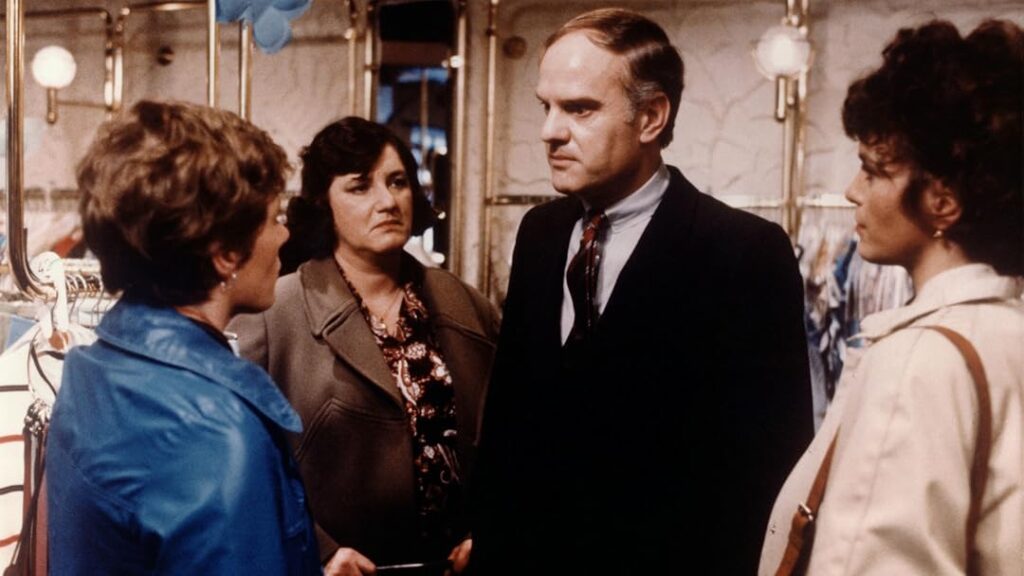
When Criterion Channel put Dutch filmmaker Marleen Gorris’s trio of feminist pictures on its service in spring of 2024, I was unprepared for how quickly she sucked me in. The way she portrays women and women’s struggles with unflinching honesty and defiant joy makes her work hit like a suckerpunch to the gut, only to be followed by a tender embrace. They’re the kind of films that speak so bluntly they leave your jaw on the floor. This trilogy: A Question of Silence, Broken Mirrors, and The Last Island, each deal with the violence of a male-dominated society and the power of women’s relationships through increasingly explicit lenses.
Gorris is willing to dive in boldly, sledgehammering our expectations in order to show us not just how the world is, but exactly what (or who) is making it that way. And in at least one case, Gorris shows what the world could be without these oppressive forces.
Her first film, A Question of Silence (1982), shows community born out of abstract vengeance. Three women who have never met beat a local shopkeeper to death, seemingly for no reason. Janine van den Bos (Cox Habbema) is the court-appointed psychologist whose job is to determine if the women were of sound mind when they committed the crime. Their guilt is never in question. All three women readily admit to the murder. It’s only a question of why.
Gorris lets the women’s stories and personalities reveal themselves slowly, in a piecemeal fashion. Christine (Edda Barends) is a harried housewife whose husband thinks of her as doing nothing all day. Annie (Nelly Frijda) is a boisterous, widowed waitress who shrugs off her patrons’ sexist jabs with a laugh before hitting them back with a barb of her own. Andrea (Henriëtte Tol) works in an office where the men are happy to treat her as nothing more than a secretary at the same time they steal her ideas for their own. With each small peek into the women’s lives, it’s simultaneously immediately clear why they killed and why the film doesn’t ask “why” — the answer is unspoken because the answer “why” is obvious.
The murdered shopkeeper is nothing but an avatar for all the men in these women’s lives that use and abuse them. These men, the ones actually causing the harm, are also men they feel they can’t attack. But this shopkeeper? Who exists in a solely female space (a women’s clothing shop) where the only witnesses are other women? Yeah, they can lash out at him.
Janine even asks Andrea at one point, “Could it have been another man?” and Andrea replies with a smirk, “Why not?” But when Janine asks if their victim could have been a woman, Andrea’s response is a firm no. And we know she’s right because it wasn’t really the shopkeeper they were killing at all, but a symbol of a system built by men for men and reliant on the subjugation of women. Women here are sisters, kindred spirits all suffering the same fate. But men? They’re the benefactors and the perpetrators of that subjugation.
All the men involved in the tale, from Janine’s husband to the judge himself, are happy to write these women off as crazy. It doesn’t seem important to them to dig deeper. Janine, however, can’t let it go. She knows they’re not crazy, and it’s only through spending time with them that she starts recognizing the prejudices of the men in her own life. It’s then that the answer reveals itself, even if she never states it aloud.
The social and philosophical questions raised in A Question of Silence all build toward a final court case where Janine asserts her findings: these women aren’t insane. The courtroom’s response is one of incredulity except for a small group of women: the witnesses to the crime itself who never came forward. They don’t laugh at Janine’s conclusion. They know Janine is right. With every scene, Gorris binds the women closer and closer together through their shared understanding and experience of the world.
The film ends with the women delighting at the inability of these men to understand a single damn thing about their lives. They exit the courtroom howling with laughter. They treat the trial like a joke because it is. They make eye contact only with each other. This is when it clicks, that this is the point of the whole film: this is how we survive. We laugh with those who see us best. It’s the only way to fight through the absurdity of a world we might not be able to change. That A Question of Silence ends with the image of women holding each others’ gaze, while a man desperately begs for their attention in the background to no avail, is what Gorris wants us to focus on.
In Broken Mirrors, the violence and the bleak understanding of the world we live in are ratcheted up. Here, we focus on an Amsterdam brothel called Club Happy House and the daily comings and goings of the women who work there. The twist? Outside the club, there’s a serial killer on the loose picking off women on the city streets.
Here, the violence isn’t limited to one specific brutal act or even to metaphorical and emotional violence. In Broken Mirrors, violence is everywhere. It’s inside the brothel in the form of degrading jabs and requests and even occasional assaults from the johns, and dehumanizing demands from the male brothel owner. But it’s also apparent in the outside world, as the killer targets women who are supposed to be “safe” (housewives, middle-class women, students) from the very violence prostitution is said to “invite.”
Broken Mirrors has us spending most of our time with Dora (Henriëtte Tol from A Question of Silence), a hardened pro at Club Happy House, and Diane, the new girl learning the ropes. Dora and Diane quickly form a true friendship, and so much of the goings on inside the brothel feel like any other workplace. The women talk, laugh, and annoy each other, which feels like Gorris’s way of stressing that this is just a job, and that these are just people like you or me.
When violence does invades the brothel, it does so dramatically and horrifyingly. Men are always a threat to these women. It’s their control over money and thus over their livelihoods that puts them in danger. The owner wants a BDSM angle for the club and the women don’t? Well, he’ll fire them if they say no so they say yes. They have only the illusion of independence in a world owned by men.
But Gorris doesn’t believe this dynamic is the result of the women’s decisions to work in brothel, which is why she goes out of her way to show the serial killer’s starvation and torture of a simple housewife. The serial killer’s victim isn’t safe just because she’s made the “right” decisions. Women are all at the mercy of men in some way or another.
So then is the companionship and camaraderie offered by the women amongst each other pointless? Does its inability to prevent the harm of men render it useless?
Absolutely not.
In our final act, the women have just returned from bringing one of their own to the hospital after a deranged john slashes her. A seemingly benevolent man is the one to drive them, but of course after he drops them off he wants recompense. Offers to pay for his dry cleaning or get him some special treatment next time are turned away. He wants a fuck now, and with a smirk keeps adding bills to his hand with every refusal. He wants his piece of meat and he’s sure another buck with get him a yes.
Instead, Diane grabs the loaded gun the madam keeps on hand for safety and points it at his head. The women stand together in solidarity, even the ones that need the money most. Diane chases the faux do-gooder out before she and Dora quit Happy House Club for good. The stronger the bond between the women (as Dora and Diane have become best friends by this point), the more they’re able to free themselves of men’s control. They don’t judge the other women for staying, nor do the others seem to judge them for leaving.
The choice in Broken Mirrors seems to be that if men are going to enact violence on women no matter what, then the women might as well try to live the lives they actually want to. And if they aren’t free to do that, then thank god they have each other.
For Gorris, men’s violence is a foregone conclusion because it is structural. Oppressive patriarchy built the house we’re all living in, and we can’t be surprised that its foundation is festering. This knowledge is what leads us to The Last Island, the final film in Gorris’s feminist trilogy.
In The Last Island, Gorris gets downright philosophical. The crux of the film is a thought experiment similar to one put forth by Belgian author Jacquline Harpman in her 1995 novel I Who Have Never Known Men: What would the world be like if we could start over? If the systems that have always governed us no longer existed, who would we be?
In the film, survivors of a plane crash find themselves on a deserted island. There are only seven of them: five men and two women. At first, the mission is exactly what you’d expect: survival and rescue. They aren’t likely companions, but for the most part they work together well to find food, water, and some sort of shelter. Unfortunately this agreement on the priority of base survival only lasts as long as the thought of rescue feels both certain and relatively immediate.
As the days turn to weeks, cracks in their micro-society start to appear. The men begin to fall back on their most toxic impulses as a way to get through it. During one such breakdown, the youngest of the group Jack (Ian Tracey) cries, “I don’t wanna live here!” Joanna (Shelagh McLeod), the younger of the two women, replies factually, “You have to. You have no choice. It’s like hoping for the moon to come down and talk to you!” Jack responds, “I want the moon to come down and talk to me!”
Incapable of accepting their circumstances, Jack is desperate for the impossible. As their fate worsens and their prospects seem more and more bleak, Nick (Kenneth Colley) the ex-military man and most devoutly religious of the group, seizes power with violence, causing all hell to break loose. Convinced there’s nothing out there, no world to even go back to, Nick informs Joanna she needs to become pregnant to keep the human race going.
What’s horrifying here is the way Gorris immediately has Joanna call out the impracticality of this. If there really are only seven of them left, then her having a baby won’t do anything. But the men, even those who’d been her friends and protectors until that point, are completely undeterred. They pressure her to give in, beg her to give them a baby, to give them life, as a way to hold onto hope. Finally, depressingly, she does. “I think our island will disintegrate if I don’t become pregnant… so I’ve decided to become pregnant,” she decides sadly.
But even this act of pure selflessness cannot prevent the mission from failing. It’s doomed from the start because the men cannot control their violent impulses and it’s not long before they start killing one another. In a harrowing finale, all of the men die by each other’s hands. Only Joanna and elderly Mrs. G. survive. Furious Joanna yells, “You all wanted life on this island! So why couldn’t you live?!”
In “Community as Curse: The Pulp Trilogy of Marleen Gorris” author Bryan Fuller takes the film as proof pudding of Gorris’s misanthropy and bleakness, and I can see why. Gorris is a realist about the sexist fabric that makes up our society, and she doesn’t have solutions for us. But that assessment is missing something else that The Last Island, and indeed all of Gorris’s works maintain: hope.
Yes, the island’s social experiment failed, devolving into chaos and violence. But why? Because the men reverted to the toxic structures that have been designed to control and punish for thousands of years. The weakness Gorris maligns here is not human companionship, but the masculine desire for dominance and their inability to handle their emotions.
Where Fuller sees misanthropy, I see Joanna and Mrs. G. sitting together on the beach, looking to the horizon and the future. Even after the bloodshed, they’re still making plans to build a boat to take them away from the island toward the mainland they know is out there. Neither has given up. The film ends with the two of them laughing together. “I enjoy life!” Mrs. G. says with a smile, “There is after all, nothing else.”
That’s the hope that runs through these works of Gorris’s. Her hope doesn’t presume to be able to solve all the societal ills women face. It can’t eradicate them. What her work does is recognize the pain and trauma that can be inflicted on women in this world and make her female audiences feel seen. This trilogy exists as if to say, “I see you. I get it.” But instead of leaving it here, each film ends with women finding community and friendship with each other as a way to say this is what can make surviving the rest worth it. There is after all, nothing else.