It was about ten minutes into Christopher Nolan’s The Odyssey that it hit me: “Oh, this is really doing The Odyssey.” I had a similar realization a few years ago watching Guillermo del Toro’s Pinocchio. That film’s another adaptation that, beautiful visuals aside, is really doing Pinocchio. That little wooden boy gets swallowed up by a whale and you, the audience, are tasked with wrestling with just what the hell that’d be like (which I didn’t particularly care to, unfortunately).
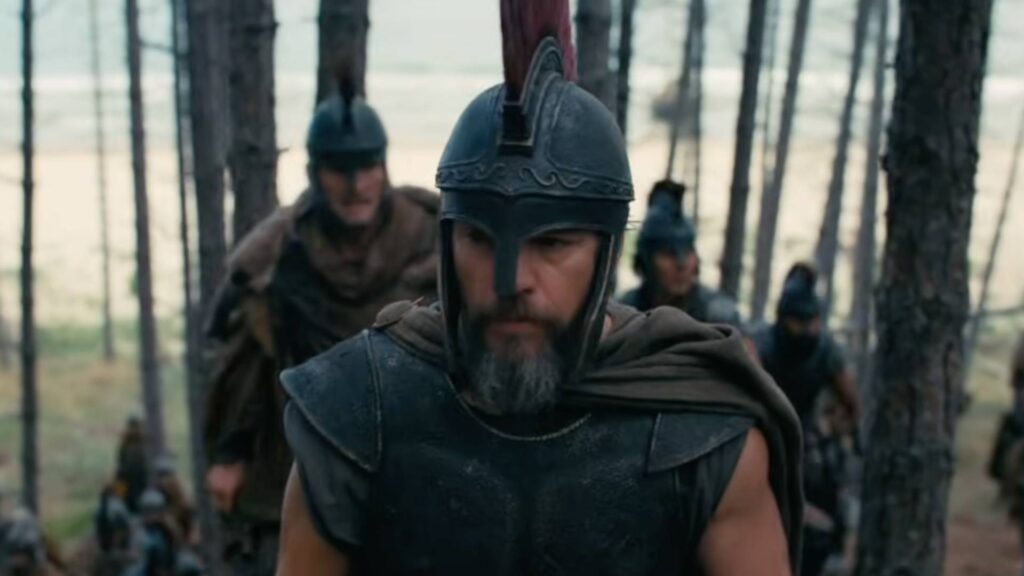
Now, should I have expected the movie billed with the same title as Homer’s epic poem to be anything other than a visualized version of that epic poem? Probably not. But, it didn’t help that a handful of riffy, “treat the source material as a jumping off point rather than something to slavishly recreate” adaptations from the past few years, including one of Nolan’s own, have all succeeded by either drastically rejiggering their source material’s structures or just out and out cherry picking the elements they wanted to keep and discarding the ones they didn’t. All of this is to say that the stumblings I had with the film may well be my stumblings. If you’re the type of person who’s always been dying to see a bunch of armored up dudes tangle with the cyclops Polyphemus or see what Odysseus (Matt Damon) getting strapped to the ship’s mast to listen in on that banging Siren song might have looked like; well, 2026’s The Odyssey has all of that for you and more. Plus, it has it all executed on the enormous, singular scale Nolan’s the undisputed belt-holder of working on (this is the first film shot entirely with IMAX cameras, a feat that required a bunch of complicated innovation on IMAX’s side).
Maybe I’m being a little unfair asserting that the guy effectively just trained a camera over every page of an Odyssey translation before calling it a day. Nolan’s Odyssey does make a number of substantial changes to the text, rendering the thing his own. It is, however, still the story of Odysseus getting lost after winning the Trojan War, giving even Nolan’s tinkerings a very familiar feel. While the poem is nonlinear, the film’s timeline includes the insertion of threads from The Ilyiad and The Anaeid and a removal of a number of gods and other major figures. Those changes result in a film that jumps back and forth between a disoriented, older Odysseus living out his quasi-imprisonment with Calypso (Charlize Theron) and the voyage that cost him both years of isolation and every last member of his crew, before ultimately getting him back to Ithaca to kick a lot of suitor ass.
Beyond those timeline shifts and Iliad and Aeneid borrowings, it’s the Trojan Horse sacking of Troy, in particular, that’s the film’s biggest reworking from the poem. Genuinely large spoilers here for anyone looking to avoid them—Nolan posits that act of subterfuge—which ended the Trojan War and is most thoroughly detailed in The Aeneid—as more than just cunning strategy. As with the atomic bomb in Oppenheimer, Odysseus’ little wartime innovation—i.e. violating Zeus’ Law (which we used to respect, dammit) and perverting a religious offering made in good faith—Odysseus broke something fundamental in his world.
That Oppenheimer essentially dedicated his life after the Trinity Test to trying to force the atomic genie back into the bottle is where Odysseus and Oppy fundamentally diverge. Turning back the clock, where we can, certainly appears to be Nolan’s big current preoccupation; it’s in how he’s showcasing his characters working to do so that he’s making his biggest shifts, film to film. Shades of that interest are also writ through the goofball/great Tenet, in its “the future is so fucked due to mistakes made in the present that the future is sending the means to prevent itself from coming to pass by shipping the tools for its prevention backwards in time” central device. The guy’s clearly worried about what we’ve done and the bill for our actions coming due.
While I loved the ruminations on those worries in Oppenheimer and Tenet, The Odyssey, for me, doesn’t land its riff on them quite as effectively. Oppenheimer succeeds because the film is driving toward the creation of the bomb, then examining the regret Oppenheimer had over being the guy with his foot on the gas of that process. The Odyssey reveals the specifics of Odysseus’ sin so late into its runtime that the events leading up to that revelation don’t get the added thematic heft of the revelation. The film jumps around in time, there are these awful little run-ins with giants and Poseidon’s one-eyed kid and so on, yes, but each little episodic beat plays like just another beat until you learn that they’ve all been loaded up with this “wow, maybe we shouldn’t have Trojan Horsed Troy after all, look what doing so brought us” guilt the whole time.
But, I’ll stop beating the “Oppenheimer rocks/The Odyssey is okay” drum for a second to say some nice things about it. First, The Odyssey is undeniably beautiful looking. Damon, Hathaway, and Leguizamo all turn in standout performances, the Göransson score’s a blast, Damon plucking his little bowstring to signal that whatever he’s hunting ought to know that, dammit, he’s coming, and the practical treatment of this difficult-to-imagine epic of wine dark seas and Circe’s shaping dudes into pigs in her witch’s cabin and so on does make for a lot of engaging stuff.
As for the film as a deepening of Nolan’s “perpetual sense of guilt over feeling obligated to craft these ‘great works’ while his family awaits his return” canon, I do think this is the most thoroughly imagined, rich entry to date. Penelope (Anne Hathaway) and her son Telamachus (Tom Holland) have arcs that are far more robust than Inception’s Mal (Marion Cotillard) and Cobb (Leonardo DiCaprio) and their faceless kids or Oppenheimer’s Kitty (Emily Blunt) and Oppy and their always-crying children. Odysseus and Penelope sailing off into exile together after he does finally return is the sweetest vision of a husband and wife Nolan’s put on screen to date. Yes, The Odyssey’s one great big journey story with these “what hath we wrought by violating Zeus’ law?” and “I do love my wife” threads to it—it’s just that their braiding, unfortunately, ends up as a little more of a tangle than I’d hoped.