A few months ago, I shared a meal with Steven Spielberg. Now, he does not know we shared it. I was at Rao’s in LA, which has since closed, and he happened to be there celebrating a friend’s birthday. We were just seated near each other, but I’m still counting it, and I couldn’t help dwelling on how much the guy means to me. It almost feels silly to recount his resume, as synonymous with American filmmaking as it is — Jaws, Schindler’s List, Saving Private Ryan. My guy made The GD Fabelmans (that David Lynch/John Ford scene!), he’s shaped theatre-going experiences for going on six decades now, and, as I can personally attest to from our* dinner, he’s a total sweetheart (e.g. at one point, he took a photo with the manager, who was kind of hovering around his table all night waiting to ask him for it). So, of course I found a lot to love in his latest, Disclosure Day.
On its face, the film’s an out and out retread of a number of his pet themes. It’s his fifth alien movie between E.T., Close Encounters, War of the Worlds, and Indiana Jones and the Kingdom of the Crystal Skull, it’s got a big train set piece a la The Last Crusade, and there are shadowy government functionaries beholden to no one in particular a la Minority Report… And yet, there’s this urgent, “only connect” thread braided through it that very much makes it a movie of this particular moment (albeit one told by a guy who also still profoundly believes in the power of local news, which, we love you Steven, but come on.).
The film opens with a gleefully bracing beat—a wrestler literally stomps on the audience’s POV, before Spielberg expands outward to introduce us to the nervy Daniel Kellner (Josh O’Connor). Kellner’s girlfriend, Jane Blankenship (Eve Hewson), is being held captive by the above-mentioned government functionaries, who will only release her in exchange for the stash of secrets in Kellner’s backpack. Kellner, a security specialist at the shadowy private/public technology company Wardex, has gone rogue, and he’s taken Wardex’s most prized classified materials with him—evidence, it turns out, of Wardex and the US government’s joint efforts to conceal decades’ worth of knowledge, experimentation on, and extraction of technology from aliens. Which are very much real. And have very much been trying to get the fact of their existence out to humanity.
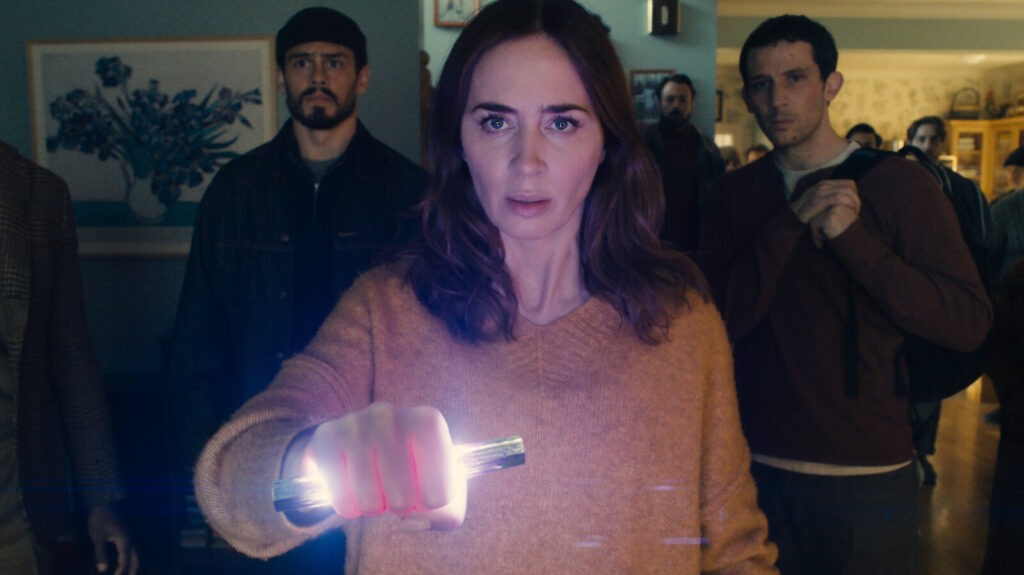
Then comes the other half of the film’s central pair—and really the biggest reason to recommend the film as a whole—Margaret Fairchild (Emily Blunt). She’s a Kansas City-based meteorologist who’s always had a sort of bug about feeling in the wrong place, ready to move at the drop of a hat to find exactly where she’s supposed to be. It turns out that the reason for that bug comes from a long-suppressed childhood experience with the aliens Wardex is doing everything it can to conceal. Both she and Kellner were chosen to share the message of the aliens’ existence.
In order to facilitate delivering that extraterrestrial revelation, Kellner was given the gift of an extreme capability with math—the “language of the universe”—while Fairchild was given a sort of extreme capacity to connect with people. Spielberg and his long-time DP, Janusz Kamiński, pull off the visualization of Fairchild’s particular strange power so, so wonderfully. In these (very cool) unbroken shots, we see characters speak first to Fairchild, who, as the camera glides behind, transitions from having Emily Blunt’s face to having the face of their loved one. It’s this seamless little clarification of exactly how Fairchild’s going to actually overcome people’s skepticism. She will speak to each and every one she has to in the most visceral, base tongue they have—literally becoming the people they love—and she’ll convince them that what she’s saying is real.
Now, is Disclosure Day full of goofball choices that maybe make what works best about it also clunk? Sure. The aliens, to me, frankly, look stupid. Kellner’s “math ability” is much more difficult to visualize excitingly than Fairchild’s speaking Korean out of nowhere or briefly becoming a Wardex agent’s kid, which makes him more of a functionary of a character than her, creating a bit of a plot imbalance. Noah Scanlon (Colin Firth), the head of Wardex’s motivation for torturing aliens and pursuing Kellner and Fairchild stems, as far as I can tell, from the belief that “government secrets should stay secret.” Which, sure, but that does feel a little thin given the extremes he and his underlings go to. And on the flipside, does the aliens’ plan make any sense at all? Relying on Kellner and Fairchild, one of whom has access to a broadcasting station and the other of whom is just so, so good at numbers, to get their message out is, I’d argue, not the greatest plan, but it is what it is. The plan does track a bit better if you extrapolate from the footage Kellner and Fairchild ultimately disclose that all the archival recordings of the aliens landing on Earth were just previous attempts to do what they’re effectively, finally, managing to do with Kellner and Fairchild, but that argument isn’t really advanced by the film, so, you’ll have to be a pretty generous viewer to grant it that (and I understand if you won’t, but come on—maybe the aliens are just getting a little kooky with their plans now that they’ve been swinging and missing for seventy years, what do we know?). And do the digital animal avatars the aliens adopt to put Kellner and Fairchild at ease look so bizarre as to be distracting? They do!
But, is Disclosure Day ultimately a fun pulpy summer spectacle with a great late-period John Williams score that’s essentially about everyone getting brought together by a major news event despite our differences? It is. And, for me, it’s very much a well-meant pro-connection sci-fi spectacle that pulls off what it sets out to pull off. Hell yeah to my Rao’s dinner date*.