On a hazy and violently orange morning in January, I woke up to a blaring alert on my phone telling me to evacuate. Los Angeles was burning, larger and faster than anyone could have predicted. The city would ring in the new year with chaos, fear, and tears. As the fires gradually extinguished, another alert came through with a blip: David Lynch was dead.
Whatever sanity I’d been clinging to snapped. I wept as if my own father had died. The man who had cracked my head open like a melon in order to show me what art and cinema could really be, the man who showed me that you could make such transcendent things while operating from a place of love, support, and kindness, was gone. And on some level, the fires had killed him. The smoke, haze, and toxic air agitated his already fragile lungs until he left us. Imagining the man who loved LA like no one else dying while it burned, never living long enough to see it rise from the ashes, devastated me.
Eleven months later, I’m standing in a crowded living room at a Christmas party when a friend sends a text that reads simply, “ROB REINER.” The all caps, single name text has never been sent for a good reason, so I braced myself. My heart went to my throat as I prepared to hear that the director had died in his sleep. Instead I saw that his body had been found next to his wife’s, murdered in his home. I couldn’t stop thinking about a man whose movies brought so much joy, that live inside of me like part of my own heart, had died in such a violent, brutal, and evil way. He hadn’t “passed on.” He was stolen from us.
These deaths bookend a year that has been cruel, both to me and seemingly to everyone I know. I find myself holding each death, one in each hand, wondering how to move forward.
Reiner and Lynch represented the two halves of my cinematic identity. There is the half with a love of genre, an affection for the rules of storytellin and the way in which structured narrative film can create some of the most endlessly rewatchable, deeply meaningful movies of a person’s life. Reiner made the kind of movies you find young and then never, ever let go of.
Then there is the half of me that dives headfirst into the unknown where the “rules” of storytelling are thrown out the window and to sit there without the words to describe what I’ve seen is a gift. Lynch’s movies may polarize in their sometimes abstract and absurdist form, but if they find a way inside your heart, they’re there for good, baby.
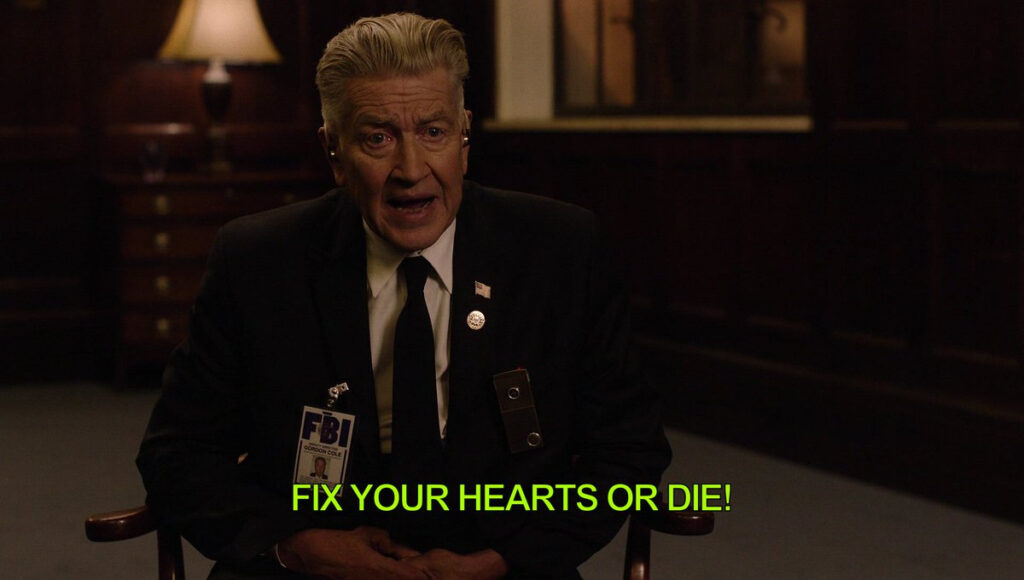
Both directors’ seemingly intrinsic goodness as much as their meaningful bodies of work makes a cruel year feel crueler. David Lynch may have been the one to say, “Fix your hearts or die!” but it was the code Reiner lived by. Ever the outsider, Lynch stayed away from politics, but Reiner was happy to throw himself in the middle of them, notoriously fighting for Prop 8 in California and rousing support for gay rights on the national level. But both made work that understood however dark and terrible the world could be, there was always hope for it to be better. It could always be made beautiful.
And now in the waning days of 2025, their ethos is perhaps the only sentiment that could rescue me from a year that hit like a battering ram. Any ground that’s felt stable — my home, friendships, relationships, my career, my goals, my dreams — has dropped out from beneath me at some point this year. And as I’ve fallen, I’ve been horrified to see my loved ones falling with me as they’re beaten down by their own miseries of the year.
But in thinking about Reiner and Lynch, I wonder if that’s how either would describe such a phenomenon. Maybe I’m looking at it all too bleakly.
Are we all falling into an abyss together? Or is the only reason we’re still standing up because we’re there to hold each other as everything else falls apart?
I’m starting to think both directors would lean toward the latter. The Princess Bride and When Harry Met Sally are strange siblings to Wild at Heart, because they’re all movies that celebrate and venerate the power of love above all else. They shout that so little else in life truly matters when compared with the infinite joys of caring for, fighting for, and supporting the people you care most about in the entire world.
When Reiner and Lynch dive into darkness, even then there’s still some sort of light. In Inland Empire, a nightmarish fever dream of a film, critic Mark Fisher insists “it is the film itself that is mad, not the characters in it.” Lynch is there to give grace and space to those navigating Hollywood, however cruel it can be. In Twin Peaks: The Return, he not only births the line “Fix your hearts or die” but spends time to celebrate love once again (between Big Ed and Norma), to condemn violence, and to uphold only the sense of law and order that includes principle and virtue.
Reiner dealt with death head-on in Stand By Me, and with misery in, well, Misery. That both are Stephen King adaptations feels apt, as even the master of contemporary horror can’t hide his hopeful streak. Stand By Me comes to grips with loss in myriad ways: the loss of childhood innocence, the loss of a brother, the senseless loss of life itself. But it endures in the way it does because it doesn’t end with death, but with an acute awareness that life goes on while we carry the memory of those we love with us. Misery isn’t quite so sentimental, instead it laughs at the absurdity of pain, leaving us with a limping but healing Paul Sheldon (James Caan) who’s used his ordeal to fall in love with his craft again. Out of the misery is born strength and hope.
So to use the deaths of these artists as some kind of metaphor for a brutal year and then to lean into hopelessness feels both antithetical to their work and their legacies. In mourning them this way, I might actually be making a mockery of them and thinking about it this way might honestly be what I need to completely reframe 2025.
I’ve been butting up against my personal failures in a way that’s been difficult to hold, but to slip into hopelessness ignores the way I’ve never actually had to hold them alone. The community I’ve built in Los Angeles held it all with me, the same way I’ve been holding their own horrors with them. “If you’re truly wild at heart, you’ll fight for your dreams,” says the Good Witch in Wild at Heart, though it could be a line talking to the boys in Stand By Me as well. Either way, it’s the line I think I’ll let stick with me a while. I think Reiner and Lynch would like that.