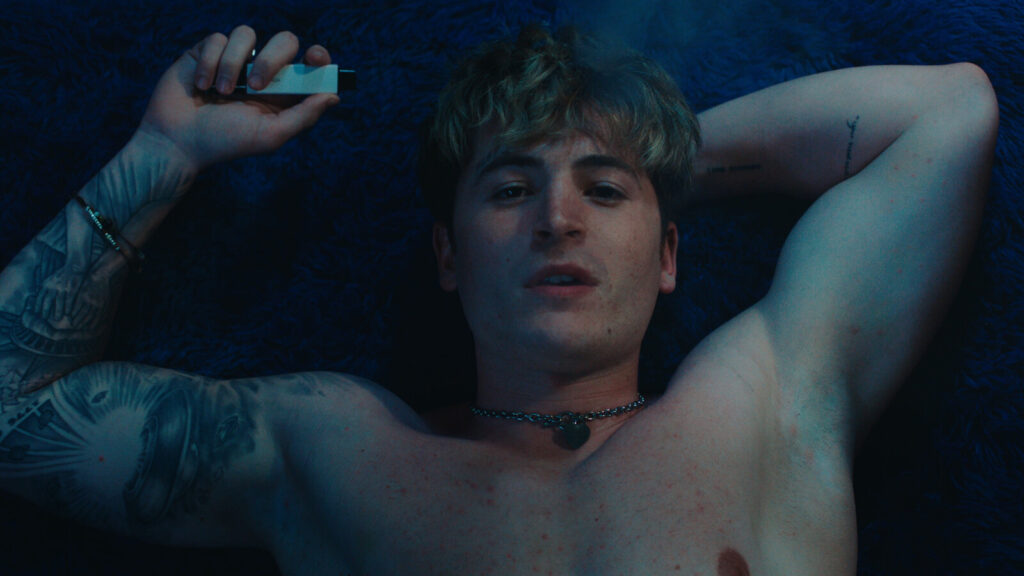
Blue Film opens on Aaron Eagle (Kieron Moore) streaming to his followers: men that he mocks for watching him, for wanting him, for not being as man as him. His followers get off on him being crass, biting, dominating, emasculating. As Aaron says later in Blue Film, “I can show my faggots who I am and they fucking love me.” The rest of Blue Film takes place in one house, with one client: a ski-masked man spending $50,000 for a night with Aaron.
It’s quickly revealed that the client is someone Aaron knew when he was just Alex — before his Aaron Eagle persona existed. Hank Grant (Reed Birney) was Aaron’s middle school teacher, and he has come to confess that he has been in love with Aaron since he taught him in middle school.
Blue Film is non-judgmental in a neutral sense. In a culture that has a tendency to rush that which is sexually repulsive into a drawer and slam it shut, Blue Film instead sits in contemplation of the lived experience of the taboo, or even immoral, desire.
Blue Film is blue like crass, blue like melancholy. It’s a remarkable chamber piece and a remarkable meditation on sex, taboo, and the possible transcendence (or nothingness) of pursuing sexual desire.
I spoke with Blue Film director Eliot Tuttle about his remarkable feature debut.
VERONICA: I’m going to start with a technical question. I’d love to hear about your process developing the color composition and camera composition in this film.
ELLIOTT: I loved using the different formats of camera. I loved this camcorder aesthetic, the format really creates this sense of intimacy and familiarity and danger. It’s used a lot for family videos but is also used for something like a snuff film. […] So [the camcorder] felt really important to implement at different moments of the film. I love the medium because there’s something so beautiful about being able to look into an actor’s eyes in extreme close-up and not feel self-conscious at all, because they can’t look back at you. This felt like a perfect story for film, because it’s already engaging with such personal and taboo subject matter. I loved the idea that people could watch this, have their own relationship with the screen, and not be worried about anyone looking at them or the actors looking at them. The color of the film was a very deliberate, long process of refining. I didn’t want this to be a film that was afraid of color in any way. A lot of my favorite filmmakers — Aki Kaurismäki and Bergman, in particular — use this really bold, expressive color as a way to express the totality of emotion. Yes, we made this film for very little money, but I never wanted the visual of the film to be an afterthought, because there has to be a reason that it’s on screen.
VERONICA: The moment I’m thinking of specifically for both color and design is the moment where they’re roleplaying. It begins in a camcorder, but when Aaron stands up we see that he’s left their [sexual] scene, because the camera has returned to digital. I feel like this kind of language is something that you can only get through cinematic presentation. The cinematic language of this movie allows for very lived-in performances, and there’s less signaling required [of the performers] for these power dynamic shifts because you’re allowing the camera to speak as well. Can you speak to the balance between getting the performance you desire while also letting the cinematic form do some of the lifting for you?
ELLIOTT: [Blue Film’s leads] Reed [Birney] and Kieron [Moore] are the part of the film I’m most proud of. They’re so good in the film and they’re such natural talents. They really made my job pretty easy. I think I was always looking for ways to guide the viewer. I’m always looking for ways to not explain things with a word. Like these people are always talking so much during the movie, it’s such a discursive, wordy film, so at every moment I could it was important to have the visual world of the film, the actual assembly of the film, kind of represent an eagerness to engage with the subject matter, too. I didn’t want this to just be that they’re talking about this lightning rod subject matter. I wanted it to be so that if you took away all the words, this would still feel like a dangerous film. I wanted to engage with the subject matter in more than just the words, I wanted to do it with the visual language as well.
VERONICA: Speaking to that lightning rod topic, what I really appreciate about Blue Film is that it has good faith in its audience, and it isn’t compromising. How did you maintain that sense of trust in your audience and in this film being received as it needed to be received?
ELLIOTT: I think I worried that if I made any creative decision out of fear then the movie wouldn’t be good. We all wanted to make this movie as good as we could possibly make it and tell the story as well as we could possibly tell it. I was conscious of learning to trust my gut instincts. I was always worried that the film was going to be bad. And also, all filmmakers should trust their audience! If people are paying for a ticket, they probably want to engage with it in good faith. You have to trust your audience. You make it to connect with an audience. It was never a question of “How do I make sure this isn’t read the wrong way by the wrong people?” because someone out there will always read something wrong. It’s impossible to make any creative decision from that place of worry.
VERONICA: This film is as close to a two-hander that I think you could get. Was one of the characters easier to understand or get into than the other when your were writing or directing? Did you see Aaron or Hank more clearly, or did you see them as mutually created?
ELLIOTT: I really like that question. They were both easier and more difficult for different reasons. The Hank character was almost easier in the way it was not a very personal character. He felt so created. But he was also harder because I did a lot of research and wanted to be as thoughtful as I could when writing it. The character of Aaron felt more difficult in the sense he felt a lot more personal to me, and it felt difficult to translate him into a character. But in the same way that also made it easier. I guess to answer your question it’s both and neither and … and they do kind of just exist together. The way the film is written they have a sort of positive feedback loop inside of this echo chamber. They are constantly pulling new things out of each other. It’s not until the end that their arcs kind of disentangle.
VERONICA: What did you feel like was at the heart of Blue Film’s grappling with sex as performance and sex as spiritual?
ELLIOTT: When I was writing the film I was never explicitly trying to write about sex as performance because these characters do feel like extrapolations of themselves. I think the character of Aaron is very real to him. His work really, really informs the way he lives his life. […] I didn’t want to make sex this conceptual thing, I wanted it to be the driving force behind their arcs. The sex is how they both live.
HIGH FEMME’S RAPID-FIRE QUESTIONS:
HF: What’s your biggest time suck online?
ET: Instagram.
HF: Favorite curse word?
ET: Fuck.
HF: Favorite perverted thing (it can be art, an object, a person, a sex act)?
ET: I’m reading this book right now [holds up Catherine Breillat’s I Only Believe in Myself: Conversation with Murielle Joudet].
HF: A sex discourse you wish you could ban?
ET: Sex scenes in movies being unnecessary. It’s not true, they’re necessary.
HF: Favorite childhood book?
ET: I will say the Catcher in the Rye.
HF: Song of the spring?
ET: “Crank” by Slayyyter
HF: Do you call it a journal or a diary?
ET: Journal, but I’ve never kept one, really.
HF: Person dead or alive that you would ask to dinner with the sole purpose of getting to throw a drink in their face?
ET: Roy Cohn.
HF: Ideal nap length?
ET: One hour. I try to take a nap every day.
HF: Best time to write?
ET: Afternoon.
HF: Worst place to edit writing?
ET: In my apartment.
HF: Any opinion on any movie ever?
ET: Salò is the best film ever made.