The greatest service The Testament of Ann Lee does for its protagonist is to represent her as neither true deity or religious fanatic. Ann Lee’s (Amanda Seyfried) most intense prophecy is childlike in its simplicity, and easy to scorn. After years of sex with her husband that she feels is impure, and the ensuant devastating loss of child after child, Ann Lee has a vision of Adam and Eve being cast out of Eden, and of herself as the second coming of Christ. The answer to a true connection with God, she realizes, is to refuse fornication of any kind.
It would be easy to belittle her revelation as a direct response to her own trauma. How convenient, after all she has suffered, that God has told her to refrain from sex and conception. But The Testament of Ann Lee, much like the Shakers themselves, takes Ann seriously. Instead of investigating the reality of her visions, The Testament of Ann Lee is more interested in Ann Lee’s very real power to seduce other like-minded people toward her.
The Testament of Ann Lee takes the heady, radical acceptance that the Shakers encourage (at the first meeting Ann Lee attends, a man confesses to lusting for his young sister, and a woman weeps for him, holding his pain as he convulses) and pairs it with the desire for salvation to make sense of Ann Lee’s mystic appeal. Seyfried plays Ann Lee in equal parts earnest, open, tortured, and driven. Her followers, in turn, feel real and textured in their sometimes reverent, sometimes conflicted experience.
People pay attention to her, both as a prophet or as a threat. You feel drawn into the group’s steady animal panting, their rhythmic and devotional dancing. There’s some undeniable, universal baseline pull toward a place where you can scream and sob with no repercussions.
Our narrator, Ann Lee’s devout follower Mary (Tomasin McKenzie), says at one point that the Shaker religion believes the religious spirit is an internal one. That Ann Lee struggles with notions of the internal are unsurprising. That which comes out of Ann Lee’s body (when not in her control) is gory, painful, and loaded with grief. Children conceived from sex with her sadistic husband are born with animal brutality and gallons of blood. But what emerges from Ann Lee when she is in control — the breath she pushes out, the thumping and writhing she twists forth from herself, her singing and ritualistic dancing — is beautiful, sturdy, trustworthy; meditative for her and compelling for both us and her followers.
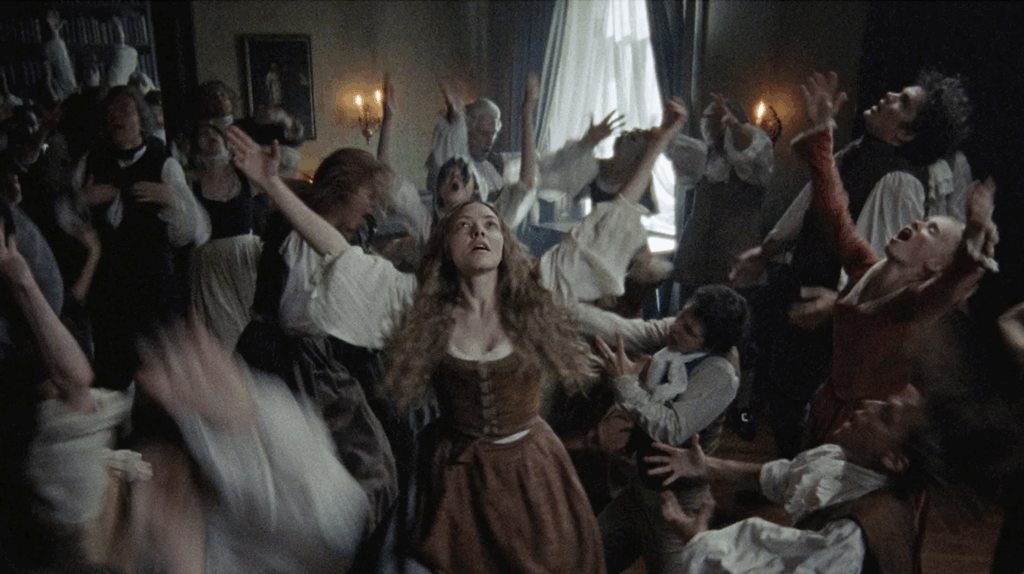
Ann Lee’s most exciting set pieces are the days-long Shaker rituals that Ann Lee first attends and eventually leads. A heaving, percussive, occasionally electric-guitar backed (!) score thrums through swaths of people seized up in religious fervor. Some move to their own accord in ritualistic gestures, others interlock in complex patterns and movements. It’s a dance-based iteration of the personal made collective and the collective made personal.
Ann Lee’s runtime moves mostly swiftly. Unfortunately, the final act of the film suffers from what many biographical retellings do, choosing accuracy and a more complete scope of Ann Lee’s life instead of a more sturdy, satisfying story structure. Much like Ann’s prophecies, the exact truth is less relevant (and maybe less compelling) than the broader implications of the story.
At the Q&A I attended, director Mona Fastvold described Ann Lee as an early feminist. While there’s a well-documented tendency toward gender equality in the Shaker movement historically (as well as racial equality — the Shakers were one of the few collectives to welcome black convents and leaders and disavow slavery), I’m hesitant to read a life dedicated in devotion to total restraint and prayer as the most inherently feminist route. (Maybe I’m personally defensive because I find some spiritual pleasure in light hedonism.)
It feels like once a day online I read someone half-jokingly wish for a life of quiet scavenging without a job, or a society devoid of men. Suggesting Ann Lee was the original American feminist feels as impossible to me as these sentiments. But there’s a seed of truth in these daydreamy, overextended idealizations. I’d be no good as a Shaker, but there’s some sort of essential, spiritual wisdom — maybe about the collective, maybe about the relief of unburdening shame, maybe about giving up some of our endless indulgences and comforts — that holds weight. The Testament of Ann Lee is worth the watch to let that spiritual potential wriggle more freely within you than usual. The Shakers would not judge you.