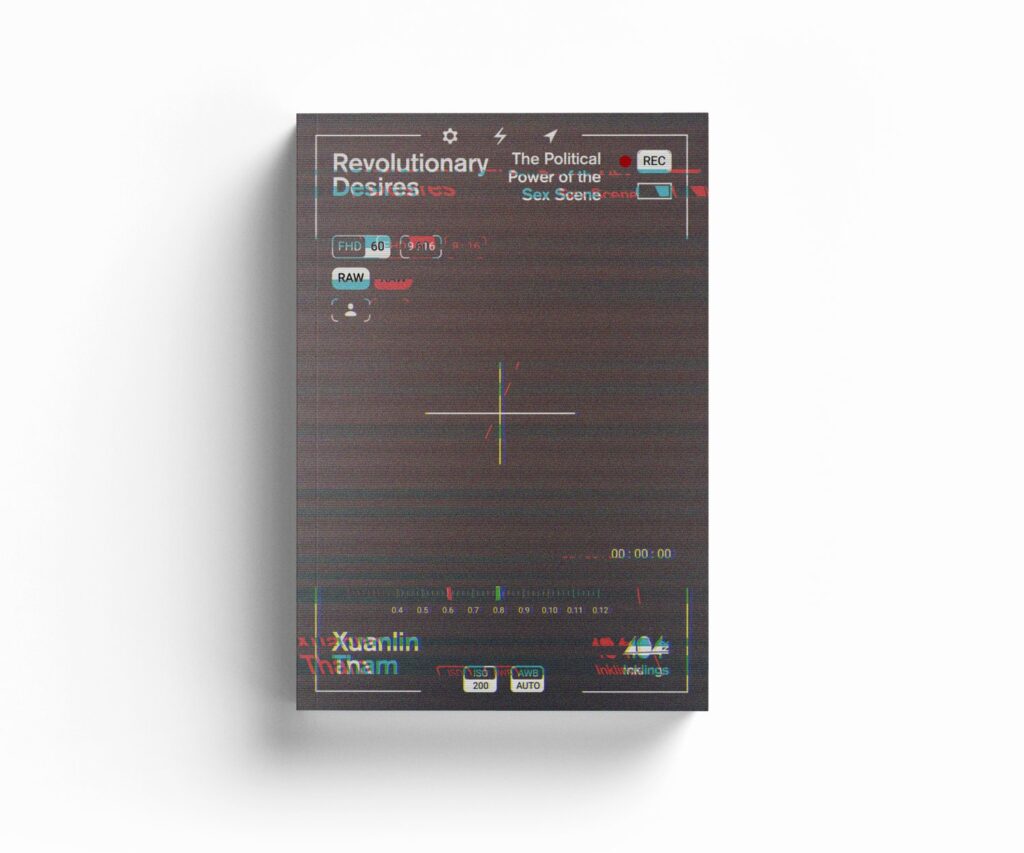
Xuanlin Tham is the author of Revolutionary Desires, an exciting and moving defense of the cinematic sex scene. The book, available in some countries through 404 Ink, frames sex on screen as a space to illuminate what we desire, what we lack, and what we may be willing to prioritize to build a better world. I had the pleasure of chatting with Tham about their book, sex scenes, discourse cycles, and our shared love of theory.
VERONICA: When did you feel like writing about the sex scene at large was of interest for you?
XUANLIN: I’ve been trying to pin it down to a specific moment. Falling in love with watching movies and really thinking about them as texts beyond just entertainment in my teens went hand-in-hand with discovering how much I loved thinking about sex and representations of sex in media. I felt, personally, more drawn to media that I had an embodied relationship to, and the sex scene was the most visceral depiction of that. […]
In terms of what made me want to write the book, the simple answer is that I was really annoyed about the way people talk about the sex scene. I particularly wanted to interrogate the idea of utility or purpose being the only reason why anything should ever exist in art. What’s our deep discomfort with things that cannot be subsumed under this more cerebral idea of artistic or storytelling purpose? […] In my dissertation [on Park Chan-Wook’s The Handmaiden] I got to explore the imagery and the effect of the sex scene as an ideational resource to combat the strict binaries and hierarchies of postcolonial narratives in occupied Korea specifically. What can the sex scene help us to imagine? How can that be a resource for us to draw on in an increasingly puritan and disembodied and very alienating time? The whole book was an opportunity to do that inquiry. It’s fun, because even after writing it, I still feel like it’s incomplete and that inquiry is still ongoing, but I was glad to have taken a first jab at it, I guess!
VERONICA: I feel like so many people in the queer and transgender community see themselves in sex and cinema in a way that isn’t a one-to-one reflection, which I love your deconstruction of in your representation chapter. A lot of my own discoveries came from cinematic moments that were not queer, or were even heterosexual, but opened doors for me to understand my lesbian sexuality. I think people get lost in the fantasy that they can just make a character queer or trans and then the work is done. I wonder if you have any thoughts on representation versus actual, felt, bodily identification.
XUANLIN: It’s partially a reflection on the potency of the medium. It’s such a powerful tool [because] immediately those discourses of identity politics and the forces of commodification appear and use the enticement of the moving image and of mass media distribution in parallel with the various political drives to, you know, commodify identity and segment our movements. I think that’s part of the answer. I loved what you said [about identity] because that is how I feel about so many films. One that was incredibly formative was the Wachowski’s Bound. I’m not a lesbian, but that film made me realize I’m nonbinary. […] Because that film is so much about how much of gender is a performance that you can weaponize to your advantage. I think it gave me a language for my relationship with both masculinity and femininity that I haven’t seen articulated as cleverly and in such a sophisticated and sexy way. I’m always reaching for a relationship with art that rejects that really collapsed one-to- one reflection that you articulated so eloquently. I think the point of art, if there is a point to it, is to always make us sense something beyond what we have. […] I don’t think constraining art to a mere representative impulse is gonna be our way out of all of these oppressions and injustices. It always comes off as a bit shallow and unimaginative for how much [art] can move us.
VERONICA: I watch some of these modern, YA gay films á la Love, Simon and Heartstoppers — which have a place, absolutely — but I sometimes fear they offer single scripts for people to follow. I don’t think it’s a problem for us to have one-to-one representation films, but I get concerned when it’s the only thing getting wide released or with real funding.
XUANLIN: Sometimes it feels like you’re almost being breadcrumbed into a cage. It’s like, “We’ll kind of appease your desire to be seen on screen, to feel at least some form of connection to the mainstream.” I think sometimes in our disappointment and frustration and loss and heartbreak and grief, we can mistake that kind of allowance as a victory. People have told me I wrote [the last chapter of Revolutionary Desires] with a real bone to pick, and I’m like, “I kind of wrote it with a bone to pick, yeah!” I think there is something quite nefarious at play in weaponizing a lot of these important and sacred ideas of community and belonging and the power of art into duping us into accepting less than we deserve and limiting our imaginations. I think that’s pretty unforgivable.
VERONICA: I sometimes feel like I’m getting this old, stale, repackaged story that keeps everything exactly aligned in how things “should be” under late-stage capitalism and completely rigid identity politics.
XUANLIN: Something nefarious about this as well is the politics of normality and the way that the borders of normality are merely occasionally opening the gates to allow some “deviants” in. That is a very scary concept. I think of the “acceptable lives” that we have imagery for. Not to whack Heartstopper again but, you know, this is still an image of a certain idea of the good life, of an acceptable way of being queer, an acceptable pitch at which to understand political struggle. A lot of the concern I have with things like this is how readily political struggle is reduced to the level of the individual. It’s about interpersonal disagreements, whether it’s coming out to a family member or being bullied at school. Yes, those things do happen, but why are we limiting the scope of this phenomenon to merely the interpersonal and not the systemic? I get especially riled up about queerness specifically being used to justify Western imperialist violence. I think that’s something that’s not the same as Heartstopper, but is on a similar continuum in terms of presenting a specific idealized image of a white, queer person who is grateful for the life that they have in the imperial core, and has also been taught that that life is fragile and can be taken away, and therefore it justifies their government “waging liberation wars” in the Middle East.
VERONICA: I’d love to talk about the sex scene discourse online. I think it’s important how you acknowledge that social media is a material part of our life now. Do you have any hypotheses on why this specific [sex scene] discourse cycles so frequently? It genuinely feels almost daily, still, and I remember it from 2018.
XUANLIN: It’s a great question because I feel the internet usually has a quite tubular digestive system – it eats something, it really enjoys it for a while, and then it moves onto the next thing. I’m always mystified by the potency of this particular conversation. I guess the answer that I’ve been thinking of is that the political stakes of what our bodies are allowed to feel keep getting higher. There’s always more and more at stake in trying to convince people that they should suppress bodily feelings, that they should suppress desire, that they should experience things that might ask them to sit in ambivalence. I think the stakes are always getting higher in terms of what we are being asked to believe so that we will not gather together as a movement to contest the violence that is being meted out against a lot of us […] I think [the sex scene] is an easy target in a way, because on the face of it there are lots of attractive discourses that get magnetized to it, like feminism or certain ways of appreciating art or morally charged strains of puritanism. It’s a sticky subject that people can weaponize easily to serve certain narratives. Because of our preexisting discomfort with sex in general, a lot of people are willing to take those feelings of discomfort, and instead of questioning why we’ve been socialized in a way to be suspicious of these feelings, just use that discomfort and say: “What everyone is saying must be right. It must be immoral, it must be anti-feminist.”
VERONICA: We are functioning under so many layers of repression, and in Revolutionary Desires you acknowledge that a lot can open up when we realize there’s abundant pleasure that we should all be able to access comfortably. I do think sometimes people are very adverse to acknowledging that sex is one of our last genuinely free pleasures that we can access in the world. I think sometimes there’s revulsion toward sex because of the lack it represents.
XUANLIN: That was the hope, I guess, when I was writing it; to illuminate that fork in the road. The sex scene can alert us that something is deeply wrong if it feels like something we lack. And by lack I don’t just mean in sex, but pleasure in general, feeling grounded in your body enough to understand that those feelings [of pleasure] are not limited to just sex. I think sex scenes open up a lot, because in sensing we can either choose to acknowledge that this is a signal that something is quite wrong with the way that things are set up currently, or we can disavow it.
VERONICA: You referenced so many of my favorite sex theorists, so I wanted to ask about your research process in terms of citing cinematic texts and academic texts.
XUANLIN: I was really thinking a lot about the strands that I wanted the inquiry to flow into. I was thinking about capitalism, but also the tributary flows of patriarchy and the commodification of identity. I think every sex scene could potentially be eligible for that kind of inquiry, but I wanted ones that sparked the bodily imagination and provided resources to imagine a different way of life. Also, I’ve been very suspicious of sex positivity as a discourse. While I feel the zeitgeist is shifting now, even a couple of years ago there was a real apex, I felt, of sex positivity. It was like, if we’re talking about sex and sex scenes, it’s with this really effusive euphoria and positivity. Which is not a bad thing, but I think it would’ve been untruthful to the topics I was exploring to not think about the enduring problems and discomforts and injustices of sex and sex scenes as well. A lot of it was trying to strike a balance between discussing sex as a source of potentially rousing and liberatory energy, but also not overromanticizing it. I was suspicious in general of anything that would align something as trivial as watching a movie that has a hot scene in it and being like, [Xuanlin laughs and makes a sarcastic “fight the power” fist gesture here] “That’s radical!”
VERONICA: I honestly sometimes think that sex scene discourse and the sex positivity movement, incidentally made sex this mystic, amazing event that’s inherently transcendent. It creates a myth where you can follow a perfect path of decisions that brings you to the perfect sexual experience, as if it’s not an often ineffable, complex bodily and mental experience to have sex and to watch sex.
XUANLIN: Yes, so true. That leads me back to the second half of your question, about the theorists. What you’re saying right now reminded me of this fascinating essay that I read on Dr. Devon Price’s Substack called Sex Neutrality. I really loved it because it articulated a lot of feelings I didn’t have the language for at the time, about why sex positivity comes off so wrong for me. In a real, utopian, liberated future, we would not have to elevate sex to this almost transcendental, mystical, savior figure. That kind of discourse has emerged as a polar opposite to the suppression and repression and shame and stigma that is associated with sex. The concept of sex neutrality is a bit closer to how I was discussing the sex scenes in the book.
[…]
But the theorists… I just knew I had to write with Linda Williams in mind. That open spirit of inquiry and curiosity that she brings to a lot of her writing and research was very instructive. I really loved Amina Srinivasin’s The Right To Sex — that is a text that I revisit all the time, and I also feel it’s a very clarion call for confronting a lot of difficult and ambiguous questions that we may not have the answers for. And Muñoz was a really, really important writer for me, especially when I was writing the last chapter. Thinking about futurity seems really difficult to do at the moment […] But I think his mode of engagement with art, which was very much using art as a portal to sense something that is not yet here, was illuminating for me in terms of what I am trying to do with the sex scene.
VERONICA: You seem to cite a balance of matter-of-fact, almost anthropological culture writers, and writers who are more theoretical or abstract. Was that intentional?
XUANLIN: I think it’s probably reflective of my reading habits. Theory really excites me. Maybe that’s not really cool or chic to say, but I think it has always provided me with a new lease on life. It reactivates the familiar in a completely different way. I think moving through these films can be a different experience every time if you try to look at it through the lens of, you know, watching Crash through Mark Fisher’s eyes and thinking about capitalist realism, or watching The Handmaiden through Muñoz and thinking about futurity and utopia. It’s so exciting to me to be reading things that give me a completely new way of understanding these works that I care about a lot. […] Theory doesn’t feel the same temporal pressures [as culture beat journalism] to come to decisions and interpretations, in a way that runs parallel with a lot of discussion around the sex scene. A lot of the discourse arises around the pace that people are expected to know things, process things, and have a soundbite that can be fetishized and commodified for likes and engagements. Sitting with theory is trying to reject that pace and appreciate the time and the work. [Theory] makes us come back to art in a much more deliberate way.
VERONICA: I think online a lot of us — and I include myself in this, too — believe a feeling of discomfort and ambivalence must mean something is inherently bad. Whereas I think theory is reliant on you sitting with it through the discomfort and ambivalence, and in fact [letting theory] express its own discomfort and ambivalence.
XUANLIN: The fact that we do not have the time and space to read theory is also a result of the same conditions that mean we do not have time and space to sit with art that makes us uncomfortable, or that isn’t immediately rewarding in terms of its digestibility. Reading theory can be really frustrating. After I left school, I felt like theory really opened up for me because I was choosing to spend my time with this difficult thing that I might find frustrating at first, but that I know will pay off and feel rewarding. It’s not as radical when you’re doing that in school, because that’s what you’re supposed to be spending your time doing. I’ve become even more of a grateful reader of theory after leaving the academic institution.
VERONICA: Do you have a favorite sex scene?
XUANLIN: Oh my gosh, this is so difficult. The gut feeling is one that I loved and didn’t have space to write about. I’ll give this one an honorary mention. It’s the sex scene in Mississippi Masala. It’s just so hot. […] What I love about it so much is its adoration for the human body. It’s a sex scene that really, really luxuriates in what it means to have a body, what it means to be able to feel someone touching you. It shows the way there’s something so exciting and new and unbearably intimate about getting to know someone’s body like that, especially for the first time. The way it’s shot is such a eulogy to the death of color in film nowadays and the death of texture and depth and just… [Xuanlin laughs] Beauty in general? I know a lot of people might disagree with me, but that’s a film that really understands how beautiful life is when we look at it with our eyes, and feel it and touch it. I just think that a movie culture in which we were able to have a film like that and a sex scene like that was such a beautiful era. I just don’t see any films like Mississippi Masala being made anymore, so much. That one is a really beautiful snowglobe of a sex scene for me. […] Part of it now as well is that the experience of watching sex in cinema actually makes me stressed. Having to sit with people whose actions I know are gonna piss me off … It makes me so sad because I wish I could go to the cinema and watch a sex scene and not think about how other people are dealing with it. I just want to be there and enjoy myself and give myself to the experience. But I have to worry that people are going to laugh or take out their phones or walk out of the cinema.
VERONICA: Do you have a utopian vision for how we see sex on screen?
XUANLIN: I think a utopian dream for me would be that the sex scene isn’t an exceptional encounter. It could be seen as both important and also completely not out of the ordinary. And for us to see [the sex scene] as a portal to our responsibilities to other human beings, and as a way to reconnect with our bodies that isn’t plagued by moralizing and shame. If that could happen, I think it would be such a different world.
RAPID FIRE QUESTIONS:
HF: What’s your biggest time suck online?
XT: Oh my god, um, I hate to say it, but it’s probably slime videos.
HF: Favorite curse word?
XT: I say “shite” a lot. People get shocked when I say it because I have this very American-ish international accent and it’s a very UK-ism that I have internalized from living here.
HF: Favorite perverted thing (it can be art, an object, a person, a sex act, whatever)?
XT: I’ve been thinking a lot about glory holes and public sex. I think it’s really beautiful.
HF: A sex discourse you wish you could ban?
XT: In that same sex neutrality essay (I think), Devon Price writes about that vanilla to kink essay and the valorization of kinky sex as inherently more liberatory than conventional sex. I think if we could abolish that hierarchy it would be really cool.
HF: Favorite book from childhood?
XT: Maybe this is not childhood enough, but The Price of Salt by Patricia Highsmith.
HF: Song of the spring?
XT: Let’s go with Kiss by Prince for now.
HF: Do you call it a journal or diary?
XT: Journal.
HF: Person, dead or alive, that you would ask to dinner with the sole purpose of getting to throw a drink in their face?
XT: There’s like a laundry list of people… Right now I’m going to say Kier Starmer.
HF: Ideal nap length?
XT: I think forty-five minutes
HF: Best time to write?
XT: This is so hard for me, because I thought I was one of those people that couldn’t write in the mornings, because I hate mornings. But I started getting up at 6 in the morning in the pitch-dark of winter, and I’m so sorry to tell you that it worked.
HF: Worst place to edit writing?
XT: At a friend’s house when the TV is on. I just want to chat.
HF: Any opinion on any movie ever?
XT: Tenet. Good movie.