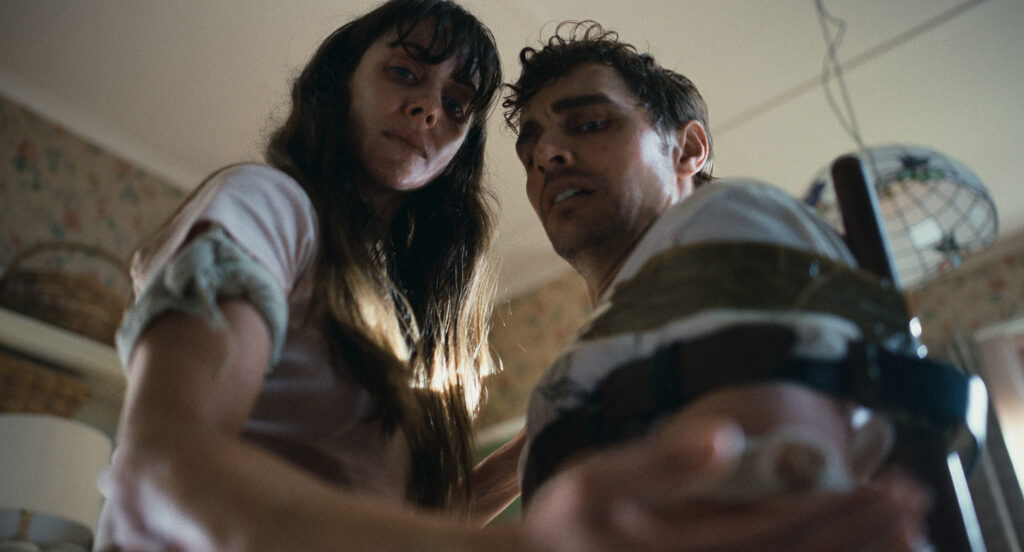
Together’s protagonists Tim (Dave Franco) and Millie (Alison Brie) have been, well, together for a long time. Nearly ten years (not that Millie is counting), We meet them as they are leaving the metropolis of their youth for the countryside, a move even more isolating than running for the suburbs. Their jobs are mobile, to a degree: Tim is a frustrated musician, and Millie a teacher. Franco plays Tim as a wounded “soft boy”, replete with beanie, slogan-y crewnecks, and the ability to quickly become passive-aggressive if emotionally threatened. Brie plays Millie with a thready tone, an idealistic educator who wears her hair and skirts long, and is drawn to traditional signals of loving commitment like regular sex and a potential marriage proposal.
There’s an irrelevancy to whether or not Millie and Tim are any good at their jobs, or if they’re good to their friends or parents. They are defined by their relationship to each other; a long one now mostly founded on memories of decades-old niceties. Together’s couple, on the surface, performs modern gender and dating “right”.
Their dating flaws, as they first emerge, have a traditionally-heterosexual, monogamous flavor. They are comfortable with each other more than they are desirous of each other. Millie wants to have more sex and be officially engaged. Tim is hesitant about leaving the city and his artistic dreams behind. These tensions are placed in an avoidant middleground, coming up in little bursts only to be tamped back down instead of meaningfully addressed. They’ll figure it out at some point. Probably. Maybe.
Once in the country, Tim and Mille journey out on a hike that leads to disaster. Trapped in a local cave with no way to crawl out, the couple spends the night huddled around an amateur fire and eventually drinking water from a small pond. The pond – butthole-esque in shape and rim — has mystical properties that cause any two creatures that drink from it to physically merge into one — a slow process that begins with a compulsive need to be near one another.
Together skirts close to a one-to-one allegory regarding the fear of being swallowed up into a village-less nuclear family. But what allows the film to have enough unique flavor to get by (aside from the obvious, squirmy, body-merging fun) is the bending and splintering of Millie and Tim’s gendered performances. In many ways, Tim adopts the role of what is usually the wrongfully-accused female hysteric. He’s needy, he has mommy issues, he’s at risk of “going crazy”. He is also actually, ultimately, correct in his gut feeling that something supernatural is compelling the pair not just toward each other but into each other. He’s a male Cassandra, and just as ignored. Millie, on the other hand, is the rational one. She has the nine-to-five job, and the desire for a regular sex life and stability. She grows frustrated with Tim’s needy, doe-eyed clinging, sometimes snapping at and dismissing him, acting at moments as the tired and suspicious husband.
When their bodies are in early stages of enmeshing, the physical interconnections read as signs of youthful, sexual love. They wake up with their sticky thighs connected in the cave. They fuck ecstatically in a bathroom stall but then cannot detach Tim’s dick from Millie’s vagina. (Anyone in the early stages of fucking someone they love likely knows the feeling). The connections eventually become more compulsive, more painful, more nonsensical. Millie and Tim’s arms crawl inside each other, bulging each other’s veins and flexing each other’s muscles. It becomes harder, bloodier, and more painful to detach. Tim and Millie are faced with a real ultimatum. Do they really want to spend the rest of their lives together at all times? Do they really want to share genes? The latter question to me reads quite obviously as a fear around having a baby, the former around marriage. It’s heterosexual-reproductive-anxiety turned human-to-human-gross-out-osmosis.
All of Together’s body horror enmeshments present a gnarly song-and-dance around a not-all-that subversive fear. The heart of Together is a trepidation about moving from being a young, hot, couple to a duo who are officially and forever partnered. Together feels like a response to a modern culture where there is less and less social, financial, and cultural requirements to commit in the traditional, institutional senses. What does it mean to agree to be together nowadays? How do you know for sure? We will be different after taking the leap, maybe, but different how? Together suggests that there is a loss of self offered in exchange for true intimacy. Scary. I’d much rather meditate on the workings of a gluey sex embrace. Anybody got some of that magic water?