There’s a seemingly-endless well of allegorical readings which might be applied to Zach Creggers’ latest horror film, Weapons. With varying degrees of rhetorical success, critics and fans of the film have posited it to be (to name a few examples): a reactionary statement on gender war panics and single women, a meditation on school shootings, a woeful parable of online radicalization, and a not-all-that-metaphorical representation of living with or around addiction. Some of these readings are compelling to me, and some are, in my opinion, dumb.
Cregger has confirmed that first and foremost Weapons is a story rooted in grief stemming from the loss of his best friend and long-time artistic collaborator, Trevor Moore. Cregger has also blanched at speculation that he’s created yet another elevated-horror grief-reflection tale, stating that his number one goal was to craft a “story [that] rips”.
The elements of grief that Cregger weaves through Weapons feel like sand slipping through fingers. Seventeen elementary-aged children vanish at the exact same time on the exact same night. They are not dead or kidnapped. They instead sprint out of their homes and vanish into the suburban streets. Ring camera doorbells and front porch surveillance rigs collect fragmented footage of the kids running toward (or maybe away from) nothing.
The sole remaining child from the class of runaways is a gentle and quiet boy named Alex (Cary Christopher), who claims to have no clue what happened to the rest of his cohort. His teacher, a young woman named Justine Gandy (Julia Garner), is distraught both over the loss of her students and the mounting hostility the bereft community exhibits toward her. She’s been put on leave and banned from talking to Alex; in part because it was her class that went missing, and in part because she has been known to seem overfamiliar with students, hugging them when they’re crying and driving them home when they miss the bus.
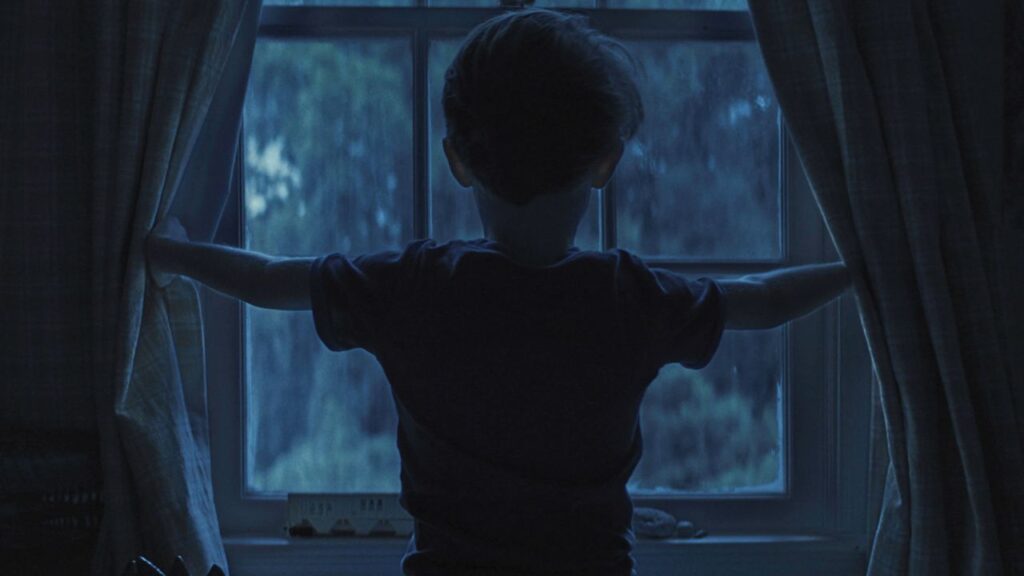
In hopes of contacting Alex, Justine stakes out his family house. It’s an average home, maybe even a little upscale, and quintessentially suburban. When Justine catches Alex on his walk home and asks how he’s doing, he answers avoidantly, off-put by her well-meaning but intense ambush. Justine watches intently as Alex opens his front door, where all that can be seen inside is a pitch-dark void. We have no sense of what sits beyond the threshold. An image meant to imbue a sense of comfort and security — a nice house in the quiet suburbs — feels like it could instead host something foul.
This unpleasant suspicion is proven to be true. Justine’s closer inspection reveals windows newspapered over to conceal the house’s contents, save for the silhouette of two adult bodies staring outward from a seat on the couch. We learn gradually that Alex’s home has been overtaken by a dark force in the form of “Aunt Gladys” (Amy Madigan), a witch-like entity preying on suburban families. (If we were going to critique Cregger for anything regarding gender, it would most definitely be—between this and Barbarian—that he seems extremely scared of an old lady looking like an old lady). Aunt Gladys is able to turn people — starting with Alex’s parents — into catatonic henchmen, waiting blankly until they are called to (usually violent) action. Under threat of grave harm to his parents by Aunt Gladys, Alex is forced to care for her thralls by feeding them cold soup and brushing their hair as they slump silently over the dinner table or on the couch. He is banned from saying a word to anyone outside of the home.
Watching Alex step into a black hole of a domicile early on in Weapons reminds me of Atom Egoyan’s Exotica. The final moment of Egoyan’s psychosexual classic is a flashback, a conversation between a man named Francis (Bruce Greenwood) and his daughter’s babysitter, Christina (Mia Kirshner), as he drives her home. We know that Francis’ daughter will soon die, and Christina will begin dancing at a strip club, likely as means of survival. But none of this has happened yet. So when Christina seems discontent as they pull up to her home, Francis is concerned. He tries to comfort her by offering a listening ear: “Listen, Christina, if there’s ever anything you wanna talk about, about what might be going on at home or whatever, know that I’m here, okay?”
Christina brushes off his offer, unwilling and ashamed to talk about whatever is happening with her family. She gets out of Francis’ car and walks down the path to her own home. It’s broad daylight on a quiet street, but when Christina steps inside her family home it feels like a bad dream. The glass of the front door reflects in a way that keeps us from seeing anything beyond it, and Christina seems to disappear into nothing.
While vastly different films, both Weapons and Exotica understand that sometimes the private, domestic sphere can be more isolating and dangerous than the public one, especially for vulnerable kids. At the club, Christina is at least fiercely protected from being even lightly touched by patrons. At school, Alex at least does not actively bear the oppressive, coercive weight of Aunt Gladys’ black magics, nor does he have to play the role of parent to his glazed-over parents.
As advocates and research have pointed out and proven time and again, child abuse, sexual violence, and abuse and trauma stemming from addiction occur far more often within the private domestic sphere than at the hands of bogeymen out in the world. One of the social questions that Weapons appears to raise most earnestly (more than grief, or trans panic, or alt right online pipelines) has to do with our irrational modern fears around the “bad guys” outside of our homes. We have created a culture that encourages mass surveillance. If we can make enough rules for the behaviors of our schoolteachers, if we can buy enough alarm systems and videotaping doorbells, if we can stock up on enough military-grade weaponry— we can keep the bad out and protect the homestead.
But all the discoveries made in Weapons via surveillance camera triangulation and showy wellness meetings with parents could have been made much more quickly if the change in Alex — the way his feet slowed to a shuffle toward what should have been the safest space for him — was tended to properly. At one point in Weapons, the visage of a giant AR-15 hovers above a home. Is it in reference to school shootings? Maybe. Or, maybe, it evokes the insular, hermetic, cynical culture of fear we have created. One that demands so much surveillance and suspicion and yet (ironically!) is so manacled by that same suspicion that authentic attempts to aid the helpless are denied. It leaves no room for openness, vulnerability, or measured and meaningful assistance from the public community. We’ve created a social combination that breeds private distress and then insists on arming it heavily. Weapons seems to posit that the call is, indeed, coming from inside the house.