
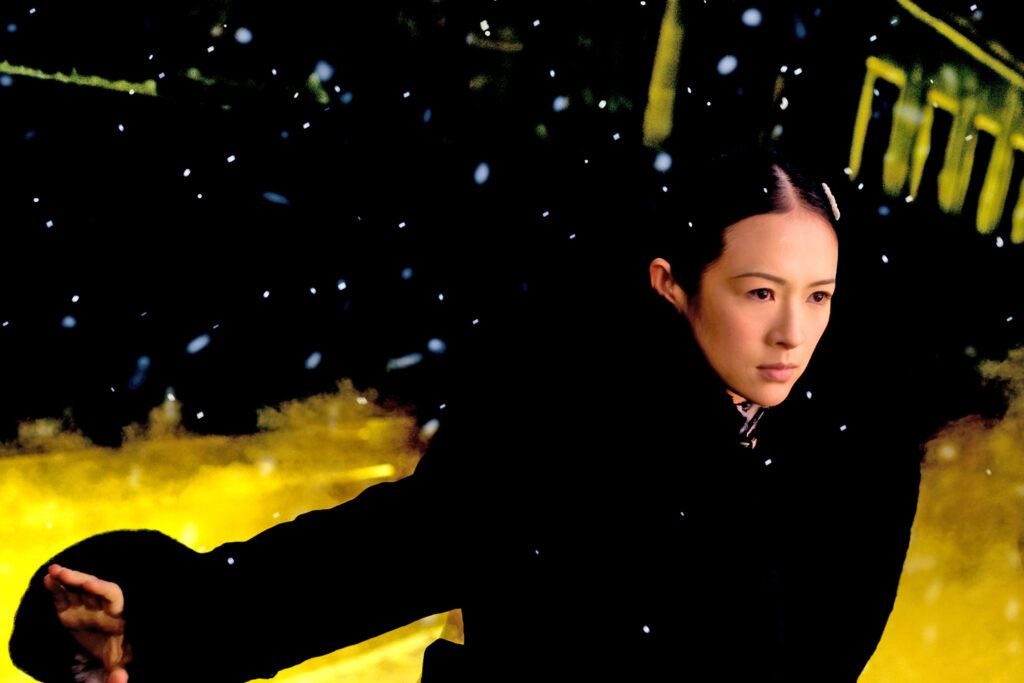
Winter as an allegory has a fascinating duality. It is an entity that both unveils and smothers, producing both crystal clear clarity by stripping the world to its barest while also burying it in snow falls, keeping it in a seemingly insuperable stasis. This deceptive and timeless purity of deadly snow lends itself especially well to a showcase for the ancient and impossible expectations society puts on women: to selflessly take care of her surroundings at the cost of herself while always projecting ease, beauty, and purity. Wong Kar-wai’s martial arts drama The Grandmaster seems like an unlikely candidate for an introspection of the patriarchal doctrine of feminine perfection and obedience – but I argue it is an extraordinarily feminist work, by juxtapositioning winterly stasis and the damning feminine condemnation of idolatry in the striking character of Gong Er, a female martial arts grandmaster and elemental force who will make herself the avatar of the dying grand age of martial art as well as of female fury in order to overcome the shackles imposed on her for her gender.
Initially, Wong Kar-wai set out to make The Grandmaster as the biopic of Ip Man (Tony Leung Chiu-wai), the martial arts master who would later teach Bruce Lee in his Wing Chun Kung Fu and popularize martial arts in the whole world. But when old Wudangquan grandmaster Gong Yutian (Wang Qing Xiang) is defeated by Ip Man in a challenge, Yutian’s daughter, Gong Er (Zhang Ziyi), enters the film and steals the spotlight for the rest of it. Wong Kar-wai seems to have originally created Gong Er as a contrast to Ip Man’s path, a path that, to my delight, took on a life of its own.
*
When she first appears in The Grandmaster, Gong Er arrives like a queen, effortlessly breaking through a street barricade erected for the first stirrings of war with Japan. She has come to agree with her father’s panicked disciples that him having his final fight with a southern nobody is a great disgrace. Her father warns her that the old have to make room for the young at some point, and asks for her to be open to the world. He tells her that while she has watched him fight since she was little, he called her to witness his final fight to close the circle. The repeated invocations of circularity and ‘turning back’ that both Gong Er and her father will make in the film draw directly from the internal martial art Bagua they embody. It was formed on the Taoist principle that the world is in constant change, and uses the Book of Changes, I-Ching, as the basis for both its techniques and its philosophy. Like the Bagua diagram in the heart of I-Ching, the practitioner moves exclusively in circles when fighting, changing position constantly but retaining harmony of one’s inner energy, qui, always, seeking to fuse the concepts of yin (passive and often attributed to female energy) and yang (active and commonly attributed to masculine energy). For this reason some call it “the divine style”.
Gong Yutian combined the styles of Xingyi and Bagua into a lethal form called the 64 hands, but has never taught it to his male disciples, for he considered it too dangerous – passing it on to no one but his daughter, decreeing that she cannot be his true successor for the sole reason of her sex even when she has perfected it. He declares that her life in the martial world is ending, for she is to be married and to study medicine. He wants her to have a life of healing instead of fighting, and as her father, he is the one to decide.
In his eyes, much like in the eyes of many men, a woman’s winter – the end of a life of her own – comes early: usually when she refuses to roleplay a girl any longer and must be subjugated to the dominance of another man in marriage. Gong Er at first glance seems the very image of the dutiful daughter. She is quiet, elegant and beautiful; we can tell that she venerates her father, but she only reluctantly lowers her eyes at his decree, never agreeing. She understands that in the republic, women may not be official grandmasters, but she is nevertheless very aware that she is one. Her father did not practice what he preached: he raised her to be a grandmaster only to deny her the official status and heritage of his school that she earned for the sole reason of her sex – and Gong Er disobeys him to claim it if only for a day. After her defeated father returns to the North, Gong Er drops the facade of the dutiful daughter and challenges Ip Man to a rematch to redeem the honor of the Gong family she sees wounded, revealing herself as a woman fully confident in her equality with the male grandmasters. She tells her life-long guardian as she gives him her challenge to Ip Man: “I have no chance to be as great as Father. It wasn’t my choice. But I’ll make my mark.” Ip Man, who stands for a simpler, more straight-forward form of Kung Fu, meets Gong Er’s winding 64 hands in a battle of mutual understanding: Kung Fu is about precision, so the first one to break something in the exquisite pavilion loses.
What follows is a sumptuous encounter, where both masters clearly fall in love with each other’s contrary fighting styles and philosophies, as well as each other. Gong Er takes victory when Ip Man falls and breaks a wooden step while she remains on the landing with a satisfied grin. Afterwards, when they stand at a gate lost in mist, she tells him she showed him the 64 Hands so he would remember that Kung Fu is not just about charging forward, but also looking backward, invoking the Bagua principle of circularity and holism. They agree he should come to the North for a rematch and leave in opposite directions of the door of destiny.
*
Before the two masters can have their rematch, the Japanese Invasion turns into the Second Sino-Japanese War. When the old Master Gong learns that Ma San, who he had appointed the successor of the Gong School as his best male disciple, has become a Japanese collaborator, he deems him unworthy of this role, invoking the same warning as his daughter by metaphor: there is one move Ma San has never mastered, which key is – once again – to turn back, and declares Ma San lacks this ability. In reply Ma San kills his master and remains in charge of the Gong legacy.
Gong Er goes to meet the masters of the Northern Union to demand justice for her now deceased father. The gentle mist that has previously surrounded her has turned into an icy, red furious wind as we see her again through the window of a train. Her furious charge only halts briefly when she asks her childhood guardian what her father’s last words were, and he tells her that her father forbade Gong Er from taking revenge. The men laugh at her when she declares she will avenge her father nevertheless. They tell her to get married, follow her father’s wishes, leave his legacy alive in Ma San, despite him being a traitor, and accept ‘the Will of Heaven’. Gong Er decrees that her father wanted a peaceful life for her, but that she can never find peace if she does not avenge his murder. “Maybe I am the Will of Heaven”, she answers them with divine ice in her words, before she marches into the shadows to the sound of the frosty North Wind. Winter is perseverance; and Wong kar-wai leaves no doubt that Gong Er incarnates it.
*
Paradoxically, men have always deemed perseverance and preservation the paramount virtues and duties of women. Preserve our youthful beauty, our innocence, our family and our tradition – in this world not admitting that the ultimate preserver of tradition is the teacher, denying that official position to women. They want women to persevere pain without showing it, persevere the unfaithfulness of men, and hold unending strength and selflessness for everyone but ourselves. Persevere doing what we are told.
That snow and its blinding white have long represented those tasks of ‘purity’ is no accident, for snow is the lovely face of winter’s cruel responsibilities.
We are to preserve and persevere… and to never take credit for it. Noble suffering and eternal standing back in favor of men disguised as solidified holiness and the root of the unholy male oppression of women that has gone on since centuries. When Gong Er charges on Ma San’s house, she demands her family’s legacy back from him. Ma San repeats a cherry-picked teaching of her father, their master: “Better to advance than stop.” He made it his philosophy and says it’s a shame the master couldn’t follow his own advice. He views his betrayal as an advance and reveals himself as an opportunist of both the old and the new by cruelly telling Gong Er if she wants the legacy back she has to send someone from the family for she as a woman doesn’t count, as she will marry out.
This leaves Gong Er, her father’s only and female child, only one radical option if she wants to fulfill the true preservation of her family’s legacy.
*
Gong Er knows what her father in all his other wisdom would never own up to: that she is his true successor but is denied both by him and the other men who rule her world to be recognized as such, because she is a woman.
So, standing before a frozen lake, Gong Er slips off the engagement ring that would have made her another man’s property and goes to a temple to make a sacred vow before Buddha: to never marry, to never have children, and to never teach. In essence, Gong Er disavows all the roles society wants to reduce her to with the first two vows, and recognizes their power with the last. If she never teaches her knowledge, there can be no new man to claim the Gong Legacy – and thus Ma San’s excuse is no longer valid and he has to face her. While making the vow, Gong Er burns her long, silky hair: symbolizing the sacrifice of her personal life, her shift from the balance of yin and yang to a destructive focus on yang: to make herself the avatar of both her mastery, her legacy, and finally of her age, disavowing the imposed shackles of her femininity.
I was drawn back to The Grandmaster, a film that seemed forever just beyond my grasp, when I recently contributed to a science fiction book called Stasis. Gong Er had captivated me for the ten years since I first saw her, but I never seemed able to fully understand her choices and her character. That is, until all the notions flying around her—regarding circularity, the doctrine of female perfection, revenge, devotion, rigidity, and winter—came together in a blast when they collided with the concept of stasis.
In science fiction, Stasis (Greek for standing still) describes a space or entity where time is stopped, and a force obtains infinite rigidity to become unbreakable. Stasis, to me, sums up what the world, and sometimes in defensiveness, women themselves, condemn women to.
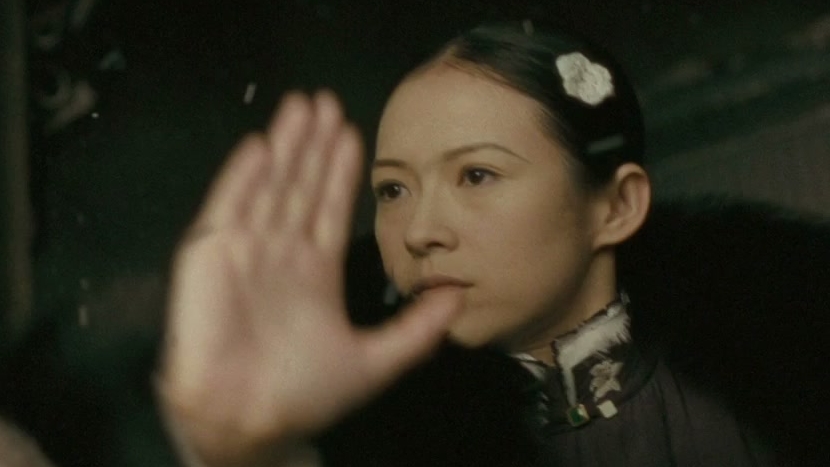
Eternity and divinity derive their power from being unchanging – from being frozen. Who can violate that which is inviolable? But life, of course, is change; and to condemn oneself to stasis is both inhuman and superhuman. After all, a frozen idol can never have any agency but the one it exists to honor, to enshrine.
Gong Er forges herself to be the idol of not only the Gong legacy but the legacy of an age; the age where to be a grandmaster was to embody the principled supremacy of what humans are capable of and to pass it onto the next generation with careful selection.
Gong Er cannot move on by the gendered corruption of the principles her father passed on to her. So when she finally battles Ma San for this legacy, it is no coincidence she chooses New Years Eve, a moment where time is transitional, and a train station, where she emerges from snow and steam like the otherworldly entity she has become to stop him on his way. She has transcended the limits of female and male, yin and yang and become the pure embodiment of the divine and merging style of the 64 hands.
As the train of time passes them by they fight in the only battle of the film that has the urgency of life and death. Gong Er moves with godly mastery of 64 hands’ circular, deadly motions while Ma San attacks with brutal confrontation. For a brief moment it seems that Ma San will win; he tries to push her head into the train, but she escapes and defeats him with the same supreme move Ma San could never master nor understand.
She briefly turns back only to push him into the train with finality. He is spun into the snow. gravely injured and defeated. He tells her that her father had used the same move on him before dying and admits to not understanding the key of turning back then – implying he now does. When he declares to return the Gong legacy to her she answers: “Let’s be clear. You didn’t return it. I took it back myself.”
So what does turning back, the key of so much of the film, mean, then? Where does it lead to?
Perhaps it is knowing when to move forward and when to turn one’s back, when to reject tradition and embrace change. To turn one’s back on sexist doctrine as Gong Er has done to become the Grandmaster of the Gong School as she rightly is and was made by her father. Not to adapt selfishly to change, but move around or with it with honor to oneself and others. Still, Gong Er’s fate can only end tragically because patriarchal doctrine still prevents her natural progression as a master and the necessary step of passing her knowledge on by the vows she had to take. She had to make herself ice in order to retrieve the Gong legacy from unworthy hands and she pays both with its, and eventually her own, life. While she leaves her triumph over Ma San seemingly untouchable, it is only when she reaches her home that we see her collapse and spit blood. The battle leaves her with grave injuries and life-long pain. The single purpose she had to sacrifice her life for fulfilled, she henceforth leads an almost ghostly existence in exile in Hong Kong like most of the old grandmasters fleeing the new regime. Here, she is finally reunited with Ip Man, and they once again find each other as a mirror of themselves. So what remains of the legacy of Gong Er, the female grandmaster of the 64 hands?
*
Ip Man, who has become a modern Kung Fu teacher in Hong Kong’s public martial arts schools, fulfilling his creed that martial arts are “for all”, seeks Gong Er out only to find her opium addicted – to bear their pain from her injuries – and more dead than alive. Nevertheless he asks her to teach him the 64 hands.
But Gong Er tells him that through being denied the natural last stage of mastery both for her gender and the vows she had to take to obtain the title, she has forgotten the 64 hands – something that neither we nor Ip Man believe. He calmly repeats her father’s words to him from when he won their fight: to always keep the faith, the flame of the philosophy and codex of the martial arts burning, and that he still hopes to see the 64 hands again.
Unlike Gong Yutian, Ip Man truly sees Gong Er as his equal. He respects women and clearly sees her as a grandmaster. What is not said in the film, and I desperately wish it were, is that the official Wing Chun lineage that Ip Man established in Hong Kong, indeed starts with a woman: Ng Mui, one of the legendary Five Elders of the Shaolin Monastery and a grandmaster of a standing denied to most female martial artists under the Qing Dynasty and the Republic like Gong Er.
It is Gong Yutian’s lack of this true understanding of the equal origins of their code that was the catalyst of the rise and fall of his daughter. The uncompromising stasis of her vows she had to achieve to operate within the patriarchally imposed doctrine of general feminine stasis, showcases both their power and condemnation; infinite rigidity might give one the power that Gong Er needed to do what she saw as her duty – but it comes at the cost of life and humanity.
She was put on the path of this impossible state of being from birth as a female – Gong Yutian’s paradoxical action of making his daughter his successor and sole heir of the divine style for fear of its dangerous might, but not granting her the official recognition a son would have gotten with it, also reveals his deep rooted fear of someone truly embodying the merging of yin and yang like his daughter.
If forced to uphold a perfection and idolatry that comes without power, like so many women are up until even today in the remaining patriarchal world order, one cannot survive as a human being, cannot win.
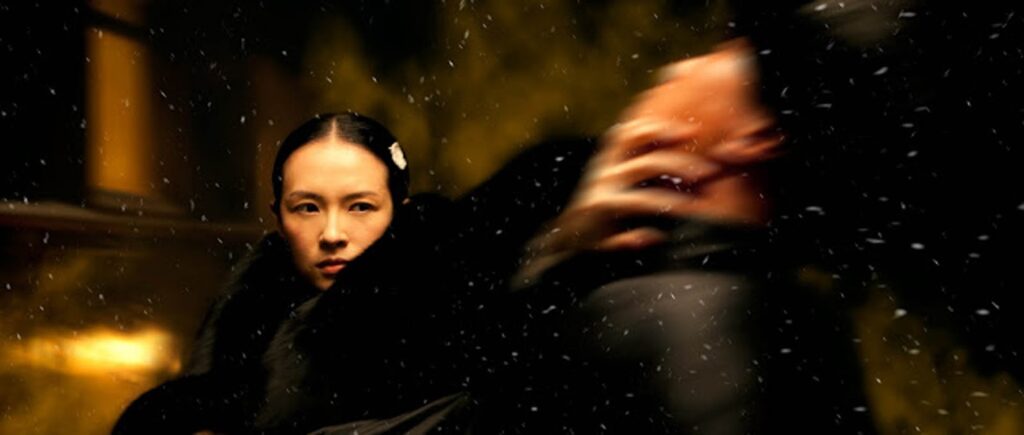
The act of extraordinary force Gong Er performed to break her idolatry took its equal toll: shortly after seeing Ip Man she dies, surrounded by opium smoke that slowly melts into the innocent snow of her youth in the north. In a beautiful and otherworldly montage, we see her childhood, where she watches her father practice the 64 hands in their garden, walking in circles and moving snow and wind as though he is connected to the very elements themselves. Young Gong Er starts to imitate his movements on her own until he happens to see her and decides to teach her. Finally, we see a crosscut of father and daughter practicing the 64 hands in harmony with the ice around them. When a grown-up Gong Er ends her form there is a clear, perfect circle in the snow around her, and she tells us that what she had learned from her father wasn’t skill, but a code of honor.
We wish she would have broken the sexist corruption of its equal origin and become an official master in Hong Kong; but it is the truth of Gong Er’s character that she never breaks with her principles, and she keeps her vows until she dies. This uncompromising faithfulness to her honor – a rigidity needed to be accepted as the successor of the 64 hands by patriarchal masters – is what condemns the fulfillment of her transcendence of the forced social separation of yin and yang. This is not to take from her triumph, but one transcendence alone is not always enough to overcome systematic oppression as we have witnessed so often in history. The end of this system needs men like Ip Man as well who will stand for the recognition of women as their equal.
The Grandmaster, Wong kar-wai’s most ambitious work, argues for a return to the naturally equal origins of both martial art and nature; to dismiss the social and gendered separation of yin and yang and for men and women to practise both. It reminds us to keep the flame that Gong Er had to bury in ice burning, and to fight for a world where everyone can add to its fire. Above all, it reminds us to strive for a world where women allow themselves to cast off the shackles of the stasis imposed on them, and to grant themselves the fragile, untamed power that springs brings after one overcomes winter.