I’ve heard it said that sex is not one of the most important parts of a marriage. This is probably said by people who don’t have sexually fulfilling unions, because I beg to differ: what distinguishes a romantic relationship from any other kind of relationship, if not sex? And, yes, while marriage may be in many ways an economic prospect, marrying for romantic love is the norm in 21st-century America. Presumed monogamy, too, is still a normative condition of modern marriage. Seems to me like sex might be kind of important.
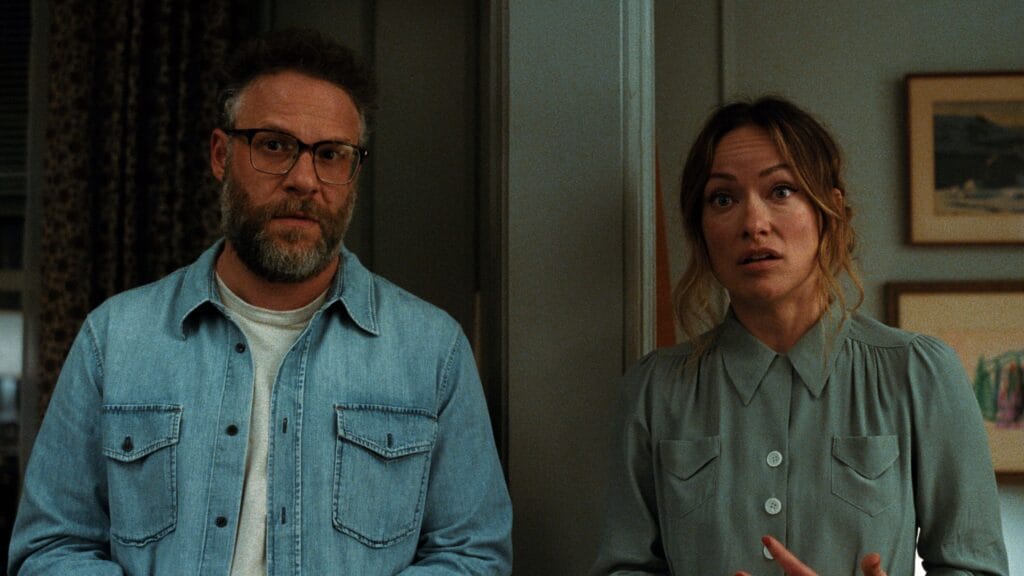
Olivia Wilde’s latest directorial effort, The Invite, asks what marriage means once the sex is gone. The film opens with music professor, Joe (Seth Rogen), returning home at the end of the workday to find his stay-at-home wife, Angela (Wilde), bustling around their apartment. Angela reminds a confused Joe that she has invited their upstairs neighbors down for drinks and charcuterie; Joe replies that she absolutely did not tell him that she invited the neighbors over. Joe is tired, dealing with chronic back pain, and not in the mood to entertain surprise guests. And these are not just any surprise guests, it turns out. These are the upstairs neighbors who have been persistently bothering Joe and Angela with their obscenely loud sex noises in the wee hours of the night. If Angela insists on having the neighbors over, Joe insists that he’s going to confront them about their disruptive late-night activities. Angela, mortified, begs him not to.
The opening bickering economically paints a picture of the type of long-married couple Joe and Angela are. They live cozily with their accumulated resentments, and may not even like each other that much anymore, but they keep it together for their kid. The film doesn’t really get cooking until ex-fireman Hawk (Ed Norton) and sex therapist Pína (Penélope Cruz) arrive, and the comedy of manners begins in earnest. Joe and Angela’s impossibly cool and hot neighbors immediately pick up on the tension, but it seems to amuse them rather than make them uncomfortable. As the night wears on, Hawk and Pína’s true intentions come out. They agreed to come over to Joe and Angela’s apartment because they’re interested in a foursome. The upstairs neighbors practice group sex (hence the excessive volume of the fucking noises), and they want to extend an invitation.
Although this reveal doesn’t happen until more than halfway through the movie, the marketing for the film heavily emphasized the sexual nature of Hawk and Pína’s interest in Joe and Angela. The offer for group sex isn’t a plot twist so much as it’s an emotional catalyst. The Invite’s script, adapted by Will McCormack and Rashida Jones from a Spanish film by Cesc Gay, uses sex—the discussion of it, the promise of it, the fantasy of it—as a shorthand for all of Joe and Angela’s desires. The movie is about sex, obviously, but it’s also about how hard it can be to find the courage and the freedom to live how you want to live in the face of life’s inevitable pressures and disappointments. The Invite remains so entertainingly unpredictable not because the sexual hijinks get out of hand, but because the emotional stakes constantly shift beneath the viewer’s feet.
A four-person cast, a single setting, and a dialogue-heavy script might sound like fodder for a play rather than a film. But Wilde and cinematographer Adam Newport-Berra pull out all the stops to make The Invite feel cinematic. Wilde is almost annoyingly fond of complicated shot set ups involving reflections and mirrors, and she studiously blocks Joe and Angela so that they often appear visually separated even within the same frame. Claustrophobic close ups in intimate moments and small spaces increase the atmosphere of discomfort. While not every visual flourish adds something, enough of them add emotional and thematic emphasis that the scale tips to the positive. Brisk editing, by Anthony Boys and Yorgos Mavropsaridis, also keeps the film from feeling too much like a play. The focus darts around the apartment from angle to angle, room to room, no scene ever given more room to breathe than it absolutely needs.
All of the main players give equally strong performances, each masterful in their own way. It’s not surprising that Rogen does most of the comedic heavy lifting, but he’s working at the top of his game here. While no one would dispute Rogen’s status as a comedy icon, he still can feel somehow generally underrated as a comedic performer, as if the effortlessness with which he carries himself on screen obscures the precision of his instincts. The Invite undeniably showcases that precision, and I hope Rogen finally gets some flowers for it. As Angela, Wilde becomes brittleness personified. It’s hilarious and heartbreaking in equal measure to watch her crack. Norton, for his part, reminded me why I had such a raging crush on him after watching The Illusionist too many times as a young teenager. Those twinkly eyes! Cruz is never less than believable as a woman so sensual it throws everyone she encounters into horny turmoil. One almost imagines that Pína became a sex therapist by default, like everyone around her was so compelled to talk about sex that she picked a career to accommodate.
As laudable as the performances are individually, the magic happens in their combination. This is the kind of movie ensemble acting awards are made for. Rogen, Wilde, Norton, and Cruz play off of each other organically, feeding off of each other’s energies. The chemistry between the four cast members, sexual and otherwise, feels right-on from scene to scene for the film’s entire time.
The Invite finds much humor in the clash between convention and deviation, repression and freedom, monogamy and free love. The thing that’s stuck with me about the film, though, is its refusal to take equal opportunity shots. While Hawk and Pína have their flaws, they’re never exposed as hypocrites ripe for ridicule. This is an earnestly sex-positive film that, in its final flipping of the script, affirms good sex and sexual liberation as a foundational part of a fulfilling adult life. Maybe group sex isn’t your path (or Joe and Angela’s), but Wilde’s film invites viewers to ask what is. Even if, or perhaps especially if, you’re old and married.