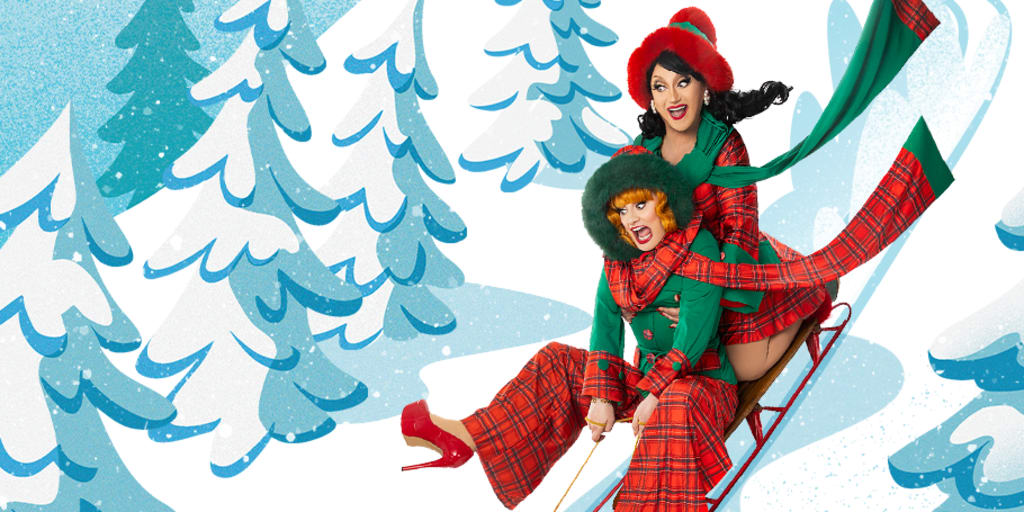
I spent Sunday night enjoying two personal gay “firsts”. I started the evening at the Tom of Finland Foundation’s holiday party, where I chatted with friends, showed off my girlfriend, admired some leather, and otherwise enjoyed mixing amid the explicitly and unabashedly gay. My second location that evening was the eighth annual Jinkx and DeLa Holiday Show at the Dolby Theatre. (As we found our seats, my girlfriend nodded to a woman in a sparkling red dress and said, “Wow, that woman’s outfit is really nice. She’s really beautiful.” The beautiful, well-dressed woman in question turned out to be Dita Von Teese, which makes that interaction the femme lesbian equivalent of being like, “Wow that guy’s really good at basketball”, and then realizing the guy is Michael Jordan.)
Both the Tom of Finland holiday party and The Jinkx and DeLa Holiday Show have existed long before my attendance. Tom of Finland’s holiday celebration coincides with the day TOM House became a foundation forty-one years ago, while Jinkx and DeLa’s Holiday Show is nearing a decade of touring. (I, embarrassingly enough, have only been a Drag Race watcher for about a year). Throughout Sunday, I found myself thinking often about the notion of tradition.
From what I could understand during the preamble at the Dolby that evening, each year Jinkx Monsoon and BenDeLaCreme attempt to put on a “normal” drag holiday show — some good, clean, song and soft-shoeing fun — but are annually derailed by a convoluted (their words, not mine) narrative obstacle. This year’s show is structured as a four-part horror anthology series, with each tale partially-narrated by a freaky-looking, Rankin Bass-style animated tree voiced by Jeff Hiller.
The show shines when you can tell that Jinkx and DeLa are doing exactly what they want to be doing. It’s delightful seeing Jinkx Monsoon stomping around in bright red platforms and a white faux fur ruff, or to see BenDeLaCreme in a candy-striped body suit. Jinkx’s affection for the classically, campily dramatic is the reason behind the best gag of the show’s first half: a Rosemary’s-baby-but-make-it-Santa gag done in pantomime silhouette. BenDeLaCreme’s cooing ditz act shines in the “Radudu” sketch, where DeLa gives up all critical thinking and emotional awareness to a part-Labubu-knock-off, part-ChatGPT trendy toysystem. The latter half of the show is undoubtedly the sturdier half, with the Radudu followed by a manic Gremlins parody–who knew how good Gizmo looked shirtless?
The second anthology segment, a body swap romp, is the closest the show gets to fan service, playing off the audience’s well-understood expectations of each queen’s drag persona. The show is, after all, a tradition–and innovation is required to keep tradition fresh. It’s also ultimately the weakest, in large part by just being too long. That said, DeLa and Jinkx are deliciously funny in their parodies of each other. As is true for all great drag queens, Jinkx Monsoon and BenDeLaCreme have an acute awareness of how they look onstage; their physical comedy is intuitive, as if they can see themselves from the audience and make adjustments in real time. (While it was the least compelling of the segments to me, Jinkx-inhabited-by-DeLa pawing questioningly at Jinkx’s ass in recognition of a surprise buttplug was the funniest singular gag of the show.) The comic expertise with which they wield nuanced gestures and vocal riffs is a delight to witness.
Jinkx and BenDeLaCreme are beloved drag queens, evidenced by their ability to pack both The Dolby and theaters across the country to the rafters, year after year after year. Their drag personalities are comfortingly legible in their campy simplicity: Jinkx is the old-school, theater-gay cynic and DeLa is little Miss Congeniality, with a skip in her step and a twang in her voice.
Jinkx and DeLa’s Holiday Show’s only flash of earnestness touches on perhaps my favorite artistic sentiment: that in the midst of all the distress of the world, it’s important to laugh. If you can make people laugh–even better. To keep the art of comedic, campy, loud, mega-gay, drag going under any and all conditions is part of this. It’s serious work to protect the silly.
It’s easy, especially right now, to see the notion of tradition as something stodgy. Is there anyone more dedicated to the evocation of Tradition with a Capital T than our fascistic government? But the more I work to understand my position in the world as a gay person (albeit an immensely privileged one), the more I feel protective of the notion of queer tradition, of our ties to our ancestors and the culture they fought to create.
Leather daddies and drag queens and dykes and transgender people didn’t just fight for a place in the world, but also built homes for us to exist within it — places like TOM house, or like the Dolby last Saturday night. These are places for us to dress as we please, to connect, and to cut loose. They’re places for us to fuck and to laugh (two of my favorite things!). There is room for me to step into these spaces, because I believe there is room for everyone to step into these spaces. But to enter them meaningfully (let alone to allow and assist with helping them to grow, morph, shift) is to understand where they stem from.
I want warmer and more open places. I want progress. But I want our progress to come from places of intention. I want for us to understand our past and to know what we want for the future. Without that, and without the cherishing of having a good party and a good laugh, we are at risk of all being drawn in by the hypnotic pull of a life without choice or critical thought, destined to live under the rule of the Radudu. .