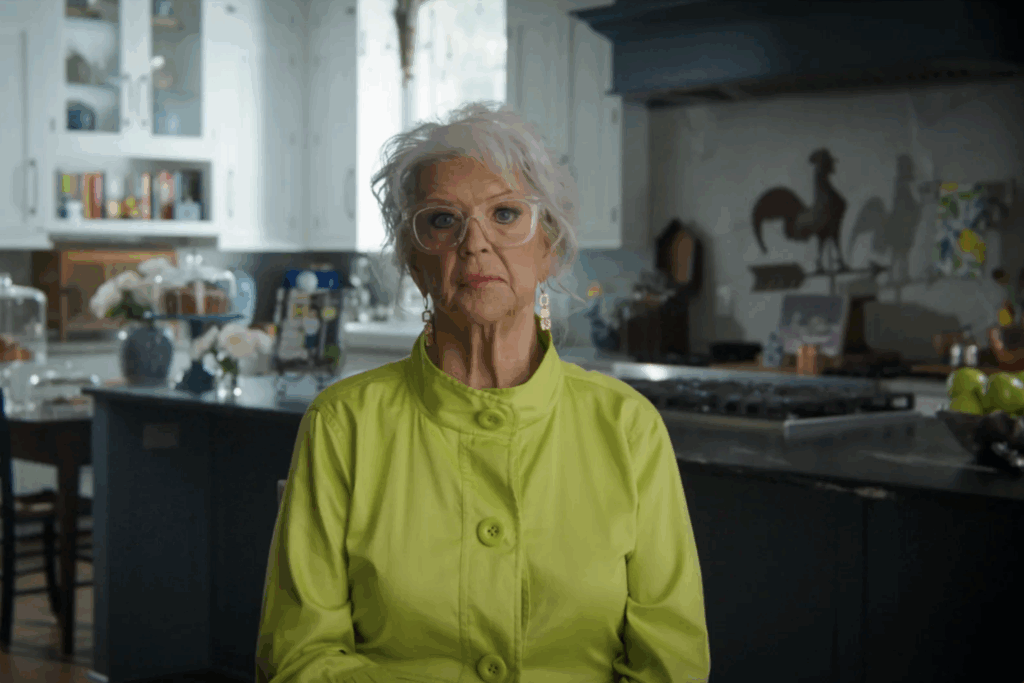
Paula Deen was on TV. Then she was memed for cooking with a lot of butter. Then, after a decade in the spotlight, she admitted to saying the N-word. A media firestorm occurred so that she was on TV even more, and then she was not on TV at all. Anything more you need to know about her (there isn’t much) you can surely Google. You do not need to turn to Canceled: The Paula Deen Story.
Canceled: The Paula Deen Story is a mission-driven documentary, set out to debunk Paula Deen’s racist persona. Not only does it fail, to me it made the matter worse. Canceled cops to Deen’s controversy immediately, presenting archival footage of the media storm that occurred after Deen admitted to using the N-word in the past during a 2013 legal deposition (her exact answer: “Yes, of course.”). Deen’s usage of the N-word is both the sole basis for the film’s existence and simultaneously only acknowledged in skittish bursts. We receive a lot of information on Deen’s climb to fame: she was charming on TV one time and then charming on TV more regularly, oftentimes with gay and/or black people, as the doc would have it. We receive a lot of other events (just not the, uh, main one) with a lot of specific dates, as if a precise timeline smacked onscreen is a meaningful practice of diligent accountability.
Whether or not her admission to saying a slur is actually a “cancellable offense” (whatever that means; am I really supposed to be distraught that some lady isn’t making tens of millions of dollars from the Food Network anymore?), Canceled wants to make both a mountain and a molehill out of the event. Canceled’s general thesis is: how sad for Deen to be caught up in something so big, when all she did was tell some teeny, tiny, mega-racial-slur truth.
Almost every time Deen’s controversy is centered in Canceled, there is an instant hard pivot to soften the blow. An excuse is thrown out by her, or one of her two sons, or her husband, or her one remaining industry friend. She grew up in a time of segregation, she’s from the South, she only said it after a traumatic incident involving a black man (?!), she would never use it with her restaurant staff, she worked with and loved many black people (even Oprah! Could a racist white woman work with Oprah? Deen and Co. think not). At other times she distracts with something totally unrelated about her childhood, or her diabetes, or her beef with Anthony Bourdain (sometimes these things fully intermingle, somehow).
Deen cries very often throughout the film, sometimes to the point of pained hiccupping. When it’s finally time to explain her, “Yes, of course” answer (after first blaming her lawyers, her PR team, and the person suing her), Deen says that the N-word usage she admitted to occurred after a black man robbed her at a bank. Deen knew this man was “more scared than her” at the time of the robbery (a detail mentioned perhaps to emphasize her radical empathy) and the N-word was said sometime later that night in the heat of the moment, during a vent to her husband. (This detail is presented as relatable, but is not to me and hopefully not to anyone I know, either). Deen, in this cobbled-together justification, hits many spots on Racist White Lady Bingo: centering herself as a victim against an aggressive black man (despite noting she–the empath– sensed his fear), claiming the safety of privacy as an absolution for racism, and avoiding the many other accusations lobbed her way (including staff allegations that Deen wanted them dressed as plantation slaves in Bill Bojangles drag for an event).
“How do you prove or disprove you aren’t a racist?” one of her sons wonders at some point, in a rhetorical defense of his mother. Hey, Baby Deen? I actually have some suggestions! I’d start with not demanding uniforms evoking plantation aesthetics in your restaurants, not saying the N-word, not then invoking the classic power dynamic of fragile white woman pitted against frightening black man, not implying that Deen isn’t racist because “only white people” seemed to care during the media firestorm, not claiming that all other accusations of racism aside from the racism included in the official lawsuit are obvious lies, not emphasizing that Deen had many black guests on her show (curiously enough, none of them are in the documentary defending her honor), not spending a significant amount of time on a story about Deen and her husband doing something nice for her longtime driver and bodyguard who happens to be black (he promises that he personally never had any racialized issue with Deen), and not solely including defenders of Deen in your doc are places to start.
Deen says at one point in Canceled that she promised her now deceased brother, Bubba, that she would clear their names in her lifetime. She jokes that that’s maybe why she’s still alive. If that’s what’s keeping her going, she may be around for a while yet.